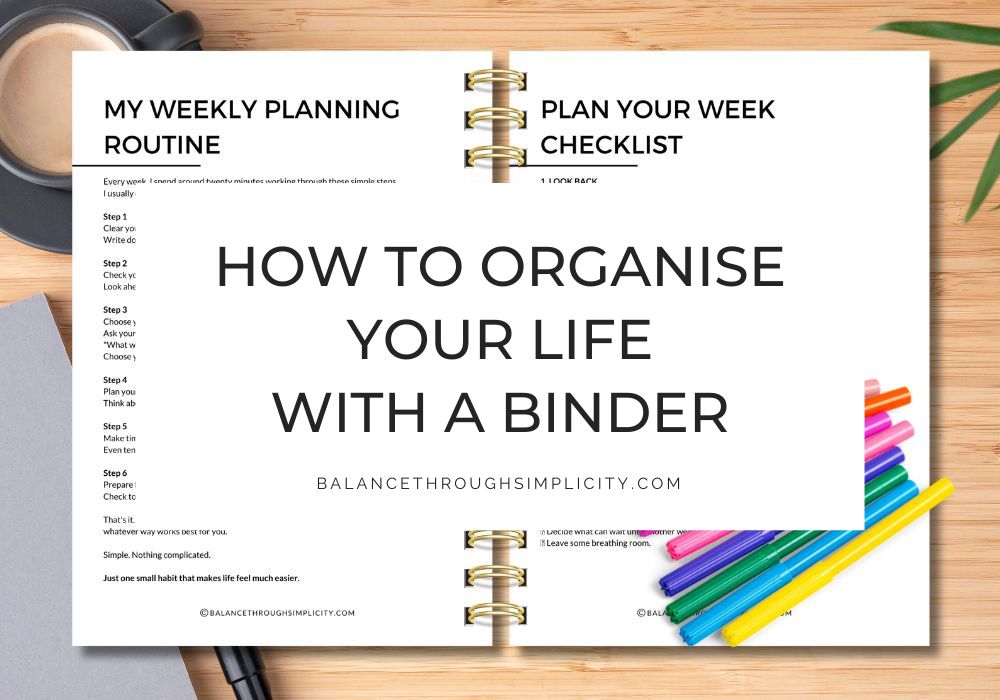
How to Create a Simple Life Binder to Organise Your Home, Time and Life
A simple life binder can give you one place to keep your plans, printables, checklists, notes and useful resources, making everyday life easier to organise. In this article, I’ll show you how to create your own life binder, what to include and how to keep it simple and useful.
DO YOU WANT AN EASY WAY TO ORGANISE YOUR LIFE?
Many of my readers love my printable resources. However, as someone who loves being clutter-free, I’m also aware that paper clutter is a problem for many of us.
I also love to organise and plan (in a really simple, stress-free way)…
So, to combine these two things together, I’ve created something that I love to use myself and I hope will help you too!
And, my solution is to build a Simple Life Binder. In this article I’d love to tell you a little more about it…
A simple life binder gives you one place to keep your plans, printables, checklists, notes and other useful resources, making them easier to find and use when you need them.
It’s an easy way to bring some order to all those bits of paper and ideas that can otherwise end up scattered around your home.
If you’ve ever printed a helpful worksheet, downloaded a planner or written something important on a piece of paper, only to lose it a few weeks later, you’re definitely not alone.
I’ve done exactly the same.
You find a printable that looks useful, print it out with all the best intentions, use it once and then… where did it go?
Perhaps it’s underneath a pile of papers on your desk. Maybe it’s in a notebook somewhere. Or tucked into a drawer because you knew you’d need it again but didn’t quite know where to put it.
This is one of the reasons I like the idea of a Simple Life Binder.
It’s not another complicated system you have to maintain. It’s simply one place to keep the things that help you organise your life.
And the best thing is that you can make it completely your own.
What is a Simple Life Binder?
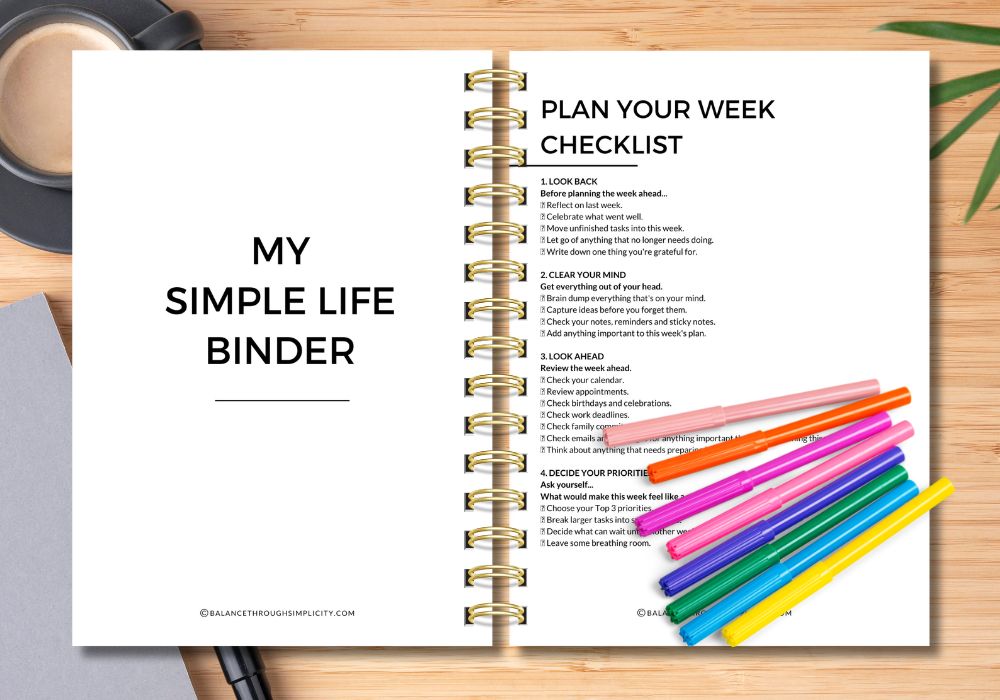
A Simple Life Binder is a physical binder or folder where you keep the planning pages, checklists, worksheets, notes and other resources that you actually use to help organise your life.
Think of it as a home for your useful paperwork.
Instead of having:
- a weekly planner on your desk
- a meal planner on the fridge
- a decluttering checklist in a drawer
- a goals worksheet in a notebook
- a routine somewhere on your computer
- and a dozen useful printables downloaded but forgotten about
…you can bring the pages you use most often together in one place.
Your binder might be very simple.
It might contain nothing more than a few planning pages and a notebook.
Or it might grow into a useful collection of routines, checklists, meal planners, goal-setting pages and worksheets that you come back to throughout the year.
There is no right or wrong way to create one.
That’s important because the purpose isn’t to create another perfect organisational system.
The purpose is to make your life a little easier.
Why use a binder to organise your life?
Modern life gives us plenty of places to store information.
We have phones, apps, calendars, notebooks, computers, email, cloud storage and countless downloads.
And yet sometimes having more places to keep things doesn’t make life feel more organised.
It can actually make things harder to find.
A simple binder gives you one physical place to come back to.
- When you need your weekly checklist, you know where it is.
- When you want to plan your meals, you know where to look.
- When you’re ready to work through a decluttering exercise, the worksheet is there.
- And when you’ve got something you don’t want to forget, you have somewhere to write it down.
For me, there’s also something helpful about putting things on paper.
Writing things down can help you get thoughts out of your head and onto something you can see and work with.
- You don’t have to remember everything.
- You don’t have to keep mentally juggling all the little things you’ve got to do.
- You can write them down, put them somewhere useful and come back to them when you’re ready.
Sometimes simplifying your life isn’t about doing more. It’s about having fewer things to remember and fewer places to look.
How to create a life binder
Creating your own life binder doesn’t need to be complicated.
In fact, I’d recommend starting small.
Here’s a simple way to get started.
1. Choose a binder or folder
Start with whatever you already have.
You don’t need an expensive planner or a beautifully coordinated stationery collection.
A basic ring binder will work perfectly well.
Choose something that is a comfortable size for you and that you’ll actually want to use.
You might prefer a larger A4 binder because it gives you plenty of room for worksheets and printables.
Or you might prefer A5 if you want something smaller and easier to carry around.
The best binder is the one you’ll actually use.
2. Decide what you want your binder to help with
Before you start printing dozens of pages, think about what would genuinely make your life easier.
What are you trying to organise?
Perhaps you want somewhere to keep:
- weekly planning pages
- daily or monthly checklists
- meal plans
- household routines
- decluttering plans
- goals
- habit trackers
- self-care ideas
- notes and ideas
- important reminders
- useful worksheets
- your favourite printables
You don’t need all of these.
Start with the things you actually need.
If you don’t meal plan, there’s no point filling your binder with meal-planning pages simply because they look organised.
Your binder should reflect your life, not somebody else’s idea of what an organised life should look like.
3. Gather the printables and pages you already use
This is where a life binder can become particularly useful.
You may already have useful pages scattered around your home or saved on your computer.
Gather them together.
Look through the printables you’ve downloaded.
Find those checklists you’ve used before.
Collect any worksheets that you know you’ll want to refer to again.
Then choose the ones that are genuinely useful.
You don’t need to keep everything.
A simpler system isn’t created by collecting more. It’s created by keeping what helps and letting go of what doesn’t.
4. Create simple sections
Once you’ve chosen your pages, you can organise them into sections.
You could use dividers labelled:
- Planning
- Home
- Food
- Goals
- Routines
- Self-care
- Decluttering
- Notes
Or you could keep things much simpler.
Perhaps you only need three sections:
Plan | Organise | Notes
There really isn’t a perfect structure.
Try something.
Use it for a few weeks.
Then change it if it doesn’t work.
That’s one of the advantages of a binder compared with a fixed planner: you can move things around.
5. Start using it
This sounds obvious, but don’t spend weeks setting up your binder before you actually use it.
Put the pages you need at the front.
Keep the binder somewhere accessible.
Use your weekly planning page.
Write down the things you need to remember.
Work through the checklist.
Add a page when you find something useful.
Remove a page when you realise you don’t need it.
Your binder is a tool, not a project.
It doesn’t need to be finished before you can start using it.
What can you put in a life binder?
The beauty of creating your own binder is that it can contain whatever is useful to you.
Here are some ideas to get you started.
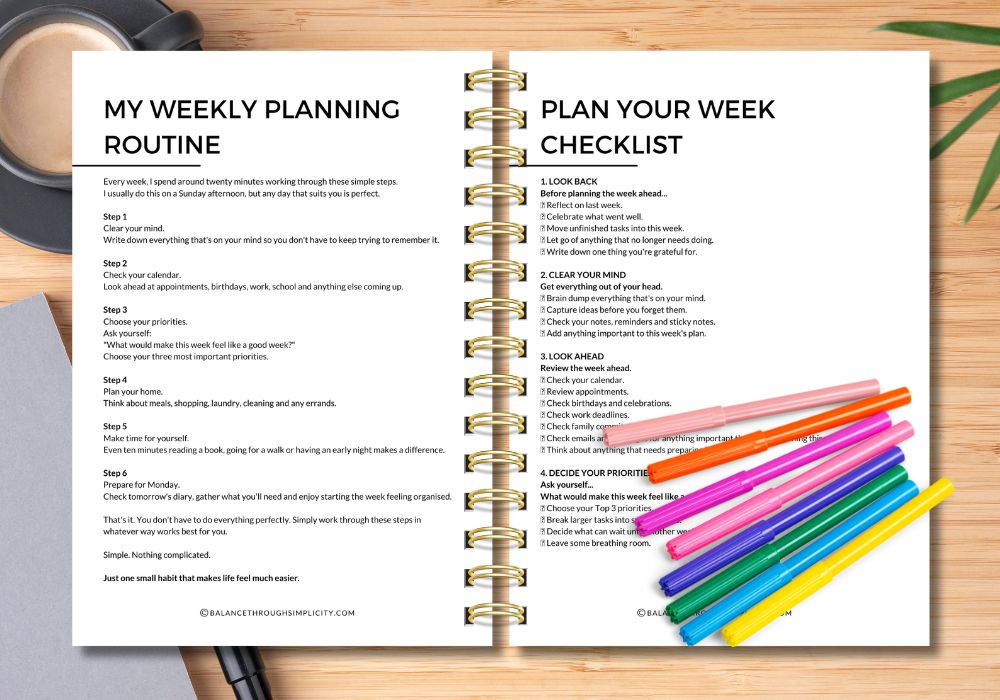
Weekly planning pages
A weekly planning page can give you one place to see what’s happening and decide what really needs your attention.
You could use it to plan appointments, tasks, meals, errands and priorities for the week ahead.
Checklists
Checklists are particularly useful when you have something you need to repeat regularly.
You might create checklists for:
- weekly household tasks
- monthly jobs
- getting ready for a holiday
- preparing for Christmas
- decluttering
- cleaning routines
- Sunday planning
- getting ready for the week ahead
You don’t have to keep remembering the same list every time.
Write it down once and reuse it.
Meal planning pages
If meal planning helps you save time and reduce the daily “what are we having for dinner?” question, add a meal planner.
You might also keep a list of family favourites or easy meals for busy days.
Goal-setting pages
Your binder can give you somewhere to write down your goals and break them into smaller steps.
This can be much more useful than simply writing a long list of things you’d like to achieve.
Decluttering worksheets
If you’re simplifying your home, you could keep your decluttering plans and worksheets together.
That way, you can work through them gradually rather than trying to declutter your entire home at once.
Notes and ideas
And don’t underestimate the value of a few blank pages.
Sometimes you just need somewhere to write.
An idea.
A reminder.
Something you don’t want to forget.
A list of things to think about later.
Your binder can be that place.
How to use printables without creating more clutter
There’s a slight irony to using printables to simplify your life.
If you download every checklist, planner and worksheet you come across, you can quickly end up with more clutter rather than less.
So I’d suggest a simple rule:
Only print what you’re actually going to use.
You don’t need a binder full of beautiful pages.
You need a binder full of useful pages.
Before printing something, ask yourself:
- Will this genuinely help me?
- Will I use it more than once?
- Does it solve a problem I actually have?
- Do I already have something that does the same job?
- Will having this page make something easier?
If the answer is no, you probably don’t need it.
And if you print something and later realise it isn’t useful, take it out.
Your binder isn’t a museum for unused printables.
You don’t need a perfect life binder
This is probably the most important thing I’d say about creating a life binder.
Don’t turn your binder into another thing you feel you have to get right.
- It doesn’t need matching dividers.
- It doesn’t need colour coding.
- It doesn’t need beautiful handwriting.
- It doesn’t need hundreds of pages.
- It doesn’t need to look like the planners you see on Pinterest or Instagram.
It simply needs to work for you.
If all you have is a binder, a few printable checklists and a black pen, that’s absolutely fine.
If you love colourful pens, stickers and page markers, that’s fine too.
There isn’t a prize for the prettiest binder.
The best system is the one that makes it easier for you to organise your life and that you can realistically keep using.
Let your binder change as your life changes
One of the things I like most about a binder is that it doesn’t have to stay the same.
Your priorities change.
Your routines change.
Your family life changes.
Your work changes.
Some months you might be focused on getting organised at home.
Another month you might want to concentrate on your goals.
Perhaps you’re planning a holiday.
Perhaps you’re trying to simplify your weekly routine.
Perhaps you simply need somewhere to put all those thoughts that are currently taking up space in your head.
Your binder can change with you.
Add new pages.
Remove old ones.
Move sections around.
Start again when you need to.
Your planning system should support your life, not dictate it.
Where to find pages for your Simple Life Binder
You don’t have to create every page yourself.
You can build your binder gradually using resources that are already available.
You might include pages from your favourite workbooks, free printables you’ve found useful, checklists from blog posts or planning pages you’ve created yourself.
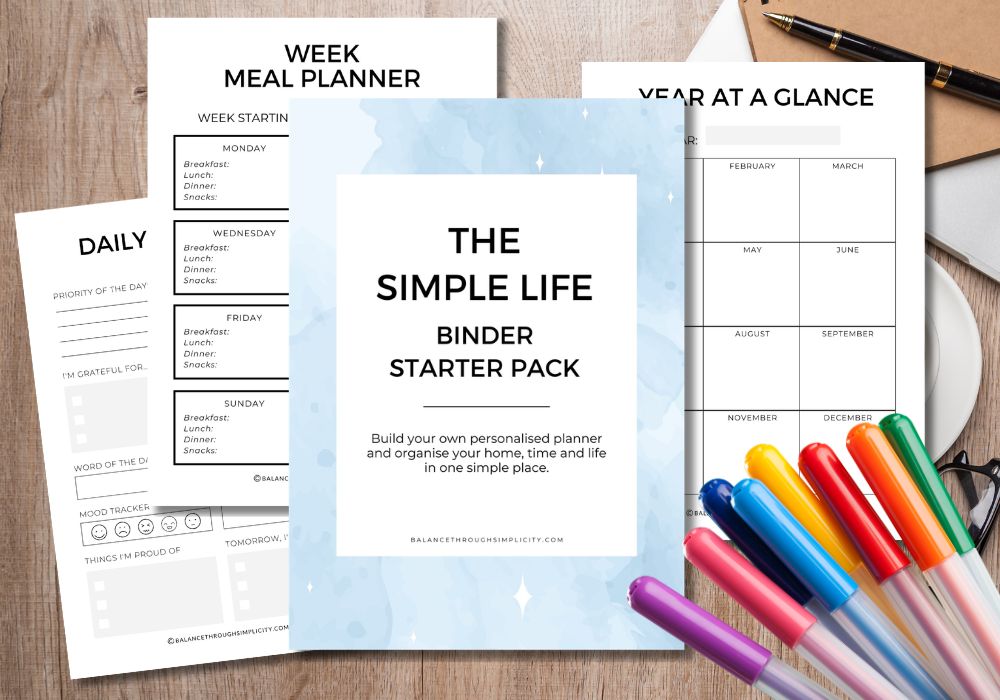
I’ve also created a Simple Life Starter Pack to make the process easier if you’re not sure where to begin.
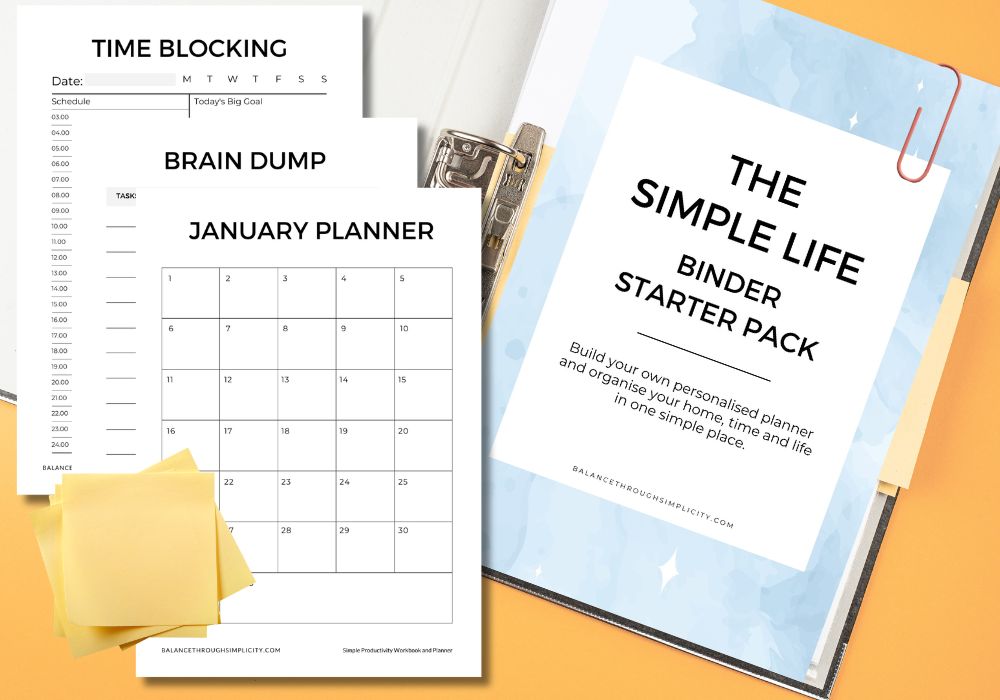
Start with the Simple Life Starter Pack
The Simple Life Starter Pack is a collection of essential printable planning pages designed to help you create the foundation of your own life binder.
It includes useful pages such as calendars, planners, routines, meal planning, goal-setting pages, habit trackers and more.
Rather than trying to work out which pages you need from scratch, you can start with a ready-made collection and then build from there.
Get the Simple Life Starter Pack
From there, you can add other pages whenever you find something useful.
- You might add a weekly planning checklist from the Plan Your Week Workbook
- Pages from the Simple Productivity Workbook and Planner
- Any of my free resources
- Printables from the Simplify Library
- All the workbooks and planners from my Shop
In fact, all my resources are designed to work together to support your simpler life (and be added to the Simple Life Binder too!)
Over time, your binder becomes a collection of the things that genuinely help you.
Your Simple Life Binder doesn’t have to stay the same
Think of your binder as a living planning system rather than a finished product.
Perhaps you start with five pages.
That’s enough.
Use them.
See what works.
Then add something else when you need it.
You might eventually have a section for weekly planning, another for household organisation and another for personal goals.
Or you might discover that you only ever use three pages and decide that’s all you need.
Both are perfectly valid.
The aim isn’t to create the most comprehensive binder.
It’s to create a simple place where the things that help you organise your life can live.
A simpler way to organise your life
Life can feel complicated when everything is scattered.
- The notes.
- The plans.
- The lists.
- The printables.
- The things you’re trying to remember.
Having one simple place to keep the resources you use regularly won’t magically solve every problem, of course.
But it can remove a little friction.
- Instead of wondering where you put that checklist, you know where it is.
- Instead of keeping another reminder in your head, you can write it down.
- Instead of starting from scratch every week, you have your planning pages ready to go.
And sometimes those small changes are what make life feel a little calmer.
So if you’ve got a pile of useful printables, a collection of half-finished worksheets or simply too many thoughts floating around in your head, why not give them a home?
Choose a binder. Add a few useful pages. Start small. And let your Simple Life Binder grow with you.
You don’t need to organise your entire life today.
You just need somewhere simple to start.
Start your Simple Life Binder with the Simple Life Starter Pack