
8 Ways to Stop Your To-Do List Overwhelming You (and Finally Get Things Done)
An endless to-do list can leave you feeling overwhelmed before you’ve even started. If you’re carrying around unfinished tasks that have been sitting on your list for months or even years, here’s how to stop your to-do list overwhelming you, take back control and feel a little lighter.
IS YOUR TO-DO LIST OVERWHELMING YOU?
Do you ever look at your to-do list and wonder how on earth you’re going to get through it all? Perhaps there are things on there that you’ve been meaning to do for weeks, months or even years. You keep putting them off, but you can’t quite bring yourself to cross them off either.
Recently, a reader got in touch to ask how to stop pending tasks from piling up. She was worried about her ever-growing to-do list and the things that had been sitting on it for years. She wanted to know how to get on top of everything and stop feeling weighed down by all the things she hadn’t done.
I suspect many of us can relate to that feeling.
Sometimes, it’s not the amount of work we have to do that feels overwhelming. It’s the mental weight of remembering everything, feeling guilty about what we haven’t done and constantly thinking about what we ought to be doing next.
Even a small task can take up a surprising amount of headspace when we keep putting it off. And the longer it sits on our list, the more daunting it can start to feel.
But here’s something I want you to remember: you don’t have to do everything on your to-do list to feel more organised and in control.
Sometimes, you need a better way to decide what matters, what can wait and what you can let go of altogether.
Further Reading: How to Simplify Your Time and Be More Productive at Home and Life
8 WAYS TO STOP YOUR TO-DO LIST OVERWHELMING YOU
Here are eight simple ways to tackle your overwhelming to-do list, make progress on those lingering tasks and give yourself a little breathing room.
1. Do a brain dump to get everything out of your head
When you have lots of unfinished tasks, one of the biggest challenges is keeping track of them all.
You’re trying to remember the phone call you need to make, the form you need to fill in, the cupboard you want to sort out, the appointment you haven’t booked and the email you still haven’t answered.
It’s exhausting trying to hold everything in your head, especially when you’re already juggling work, family, household responsibilities and everything else life throws at you.
A brain dump is a simple way to start getting on top of things.
Rather than worrying about organising your tasks or deciding what to do first, take ten minutes to write down everything that’s on your mind.
Include the big jobs, the little errands, the household tasks, the things you’ve been putting off and even those vague jobs you keep thinking you ought to do.
Don’t worry about whether you’ve remembered everything perfectly. This isn’t a test, and you don’t need a beautifully organised list. You simply want to get those thoughts out of your head and somewhere you can see them.
Writing everything down can make it easier to see what you’re actually dealing with. A task that has been taking up mental space for weeks can suddenly look rather ordinary when it’s just a few words on a piece of paper.
You might even discover that some of your tasks are smaller than you imagined, while others need breaking down into manageable steps.
Try this: Set a timer for ten minutes and write down every task you can think of. Don’t organise, prioritise or start doing anything yet. Just get it all out of your head.
Further Reading: How to Do a Brain Dump When Your Head Feels Full

2. Decide which tasks actually matter any more
Here’s something worth remembering: just because a task is on your to-do list doesn’t mean it still needs to be there.
Some tasks are genuinely important. Others were relevant six months ago but aren’t particularly important now. Some were things you thought you should do, rather than things you really wanted or needed to do.
And some have been sitting on your list for so long that you’ve almost forgotten why you added them in the first place!
When you’re reviewing your to-do list, ask yourself three simple questions:
- Do I still need or want to do this?
- What would happen if I didn’t do it?
- Is this still a priority in my life right now?
Be honest with yourself. You don’t have to finish every task you’ve ever started or follow through on every good intention you’ve ever had.
Sometimes, the most productive thing you can do is decide that something no longer deserves your time or attention.
Perhaps you planned to reorganise a cupboard, start a new hobby or research something you thought might be useful. If those things no longer matter to you, it’s perfectly reasonable to let them go.
You haven’t failed simply because your priorities have changed.
I think it’s important to remember that our time, energy and circumstances change throughout our lives. We can’t expect ourselves to keep every commitment, pursue every idea and complete every project we’ve ever considered.
Giving yourself permission to let something go can be just as useful as getting it done.
Try this: Look through your list and cross off three tasks that no longer matter, aren’t necessary or simply don’t fit your priorities any more. You don’t need to feel guilty about removing them.
3. Use four simple choices to deal with lingering tasks
If you’ve got tasks that have been sitting on your to-do list for months or years, you might be stuck in a cycle of repeatedly thinking about them without actually making a decision.
You keep telling yourself you’ll get around to them eventually, but they never quite make it to the top of your priorities.
One way to break that cycle is to give every lingering task a decision.
For each one, choose from these four options.
Do it. The task still matters, and you can realistically complete it soon. If it’s a small job, perhaps you can get it done today.
Schedule it. The task is important, but you don’t have the time or energy for it right now. Choose a realistic date or time to tackle it instead of leaving it floating around on your list indefinitely.
Delegate it. Someone else might be able to help. Perhaps a family member could take responsibility for a household job, or a colleague could help with a work-related task. You don’t necessarily have to do everything yourself.
Delete it. The task no longer matters enough to deserve your time and attention. Cross it off and give yourself permission to move on.
I particularly like this approach because it reminds us that completing a task isn’t the only successful outcome. Sometimes, making a decision about it is what finally gives us some peace of mind.
Of course, some tasks really do need doing, and important deadlines shouldn’t be ignored. But for those lingering jobs that have become a permanent fixture on your list, it’s worth asking whether they genuinely still belong there.
Try this: Choose five tasks that have been hanging around on your list for a while. Write Do, Schedule, Delegate or Delete beside each one. Then take the appropriate next step, even if that simply means removing something you’ve been carrying around for far too long.
Further Reading: Feeling Overwhelmed? 10 Things to Write Down to Clear Your Head
4. Break big, vague tasks into smaller steps
Sometimes we put things off because a task feels too big, complicated or difficult to get started on.
Take a task like ‘sort out the spare room’. It sounds simple enough, but when you think about everything involved, it can feel like a whole weekend’s work.
Where do you start? What do you do with everything you find? And what if you don’t have the energy to finish?
It’s much easier to keep putting it off than to face something that feels so daunting.
The solution is to break the task down into smaller, more manageable steps.
Instead of ‘sort out the spare room’, your list might look like this:
- Spend ten minutes clearing the floor.
- Sort through the pile of paperwork.
- Put unwanted items into a donation bag.
- Find a home for the things you want to keep.
- Arrange a time to take donations to the charity shop.
Suddenly, you have several manageable tasks rather than one enormous job.
You don’t need to finish the whole project in one go. Completing one small step is progress, even if there’s still more to do.
This works for all sorts of tasks, not just decluttering. If you’ve been putting off sorting your finances, updating your CV, organising family paperwork or planning a project, break it down until the first step feels manageable.
If you’re still struggling to start, make the first step even smaller. You might simply gather the paperwork together or open the document you need to work on.
You don’t need to feel motivated before you begin. Sometimes, making the first step easier is enough to help you get moving.
Try this: Pick one task you’ve been avoiding and write down the smallest possible action you could take to move it forward. If you can do that action in ten minutes or less, even better.
Further Reading: How to Write a To Do List to Get Things Done
5. Use the ten-minute rule to get things moving
Have you ever spent longer thinking about a task, worrying about it and feeling guilty about not doing it than it would actually take to complete it?
It’s surprisingly easy to let a small job grow in your mind until it feels much bigger than it really is.
The ten-minute rule is a simple way to break that cycle.
Choose one task you’ve been putting off and commit to spending just ten minutes on it. You don’t have to finish it. You don’t have to do it perfectly. You simply have to make a start.
You might spend ten minutes sorting paperwork, clearing your kitchen worktops, replying to an email or making that phone call you’ve been avoiding.
When the ten minutes are up, you can stop if you want to.
Of course, you might find that once you’ve started, the task feels easier than you expected and you want to carry on. But that’s a bonus, not an obligation.
The important thing is to stop waiting for the perfect time, a free afternoon or a sudden burst of motivation before you begin.
If you have a long list of small jobs, you could also try grouping a few of them together into a short session. Set a timer, focus on one task at a time and see what you can reasonably get done.
And remember, ten minutes of progress is still progress. You don’t have to complete an entire project for your efforts to count.
Try this: Choose one lingering task and set a ten-minute timer. Work on that task alone until the timer goes off. Then decide whether to stop or continue. Either way, you’ve made progress.
Further Reading: 10 Things To Do When Procrastination Kicks In

6. Match your tasks to the time and energy you have
Not every task requires the same amount of time or energy. Some are quick and straightforward, while others need concentration, decision-making or a little emotional effort.
The problem is that we often plan our to-do lists around the time we have available without considering the energy we need to complete them.
You might have twenty minutes free but feel too tired to tackle a complicated paperwork job. That doesn’t mean you’ve wasted those twenty minutes. It simply means you need a task that fits the energy you have.
Try keeping a few different types of tasks on your list.
Low-energy tasks: Put away laundry, water the plants, file a few papers or add an appointment to your calendar.
Quick tasks: Reply to a simple message, order something you need or book an appointment.
Focus tasks: Complete paperwork, plan a project, research an important decision or tackle something that needs your full attention.
Then, when you have a little time available, choose something that fits how you’re feeling as well as how much time you have.
This is particularly helpful when you’re juggling work, family, household responsibilities and everything else life throws at you.
It’s also a useful reminder that you don’t have to operate at full capacity every day. Some days you have more energy and concentration than others, and that’s perfectly normal.
Instead of criticising yourself for not completing a demanding task when you’re exhausted, choose something more manageable or give yourself permission to rest.
Being realistic about your energy isn’t laziness. It’s a way of making your to-do list work for you rather than against you.
Try this: Look at your next five tasks and label each one ‘low energy’, ‘quick’ or ‘focus’. The next time you have a spare ten or twenty minutes, choose something that suits your available time and energy.
Further Reading: Why Am I So Overwhelmed All the Time? It Might Be a Capacity Problem, Not a Time Management Problem
7. Give unfinished tasks a proper home
If you use your to-do list to record everything you might ever want to do, it can quickly become a place where tasks go to linger indefinitely.
You add something with good intentions, get distracted by more immediate priorities and then forget about it until it reappears weeks or months later.
One way to avoid this is to separate your current tasks from your longer-term ideas.
Keep one main list for things you genuinely intend to do. Give those tasks a realistic timeframe or review date, and keep everything else on a separate ‘someday’ list.
For example, if you want to redecorate your bedroom but it’s not something you’re planning to do this month, it doesn’t need to sit alongside the bills you need to pay and the appointments you need to book.
Move it to your someday list and give yourself permission not to think about it until you’re ready to review it.
You can also use a calendar for tasks that need doing on a particular date, rather than relying on your to-do list to remind you of everything.
The key is to have a system you trust. When you know where everything belongs, you don’t need to keep mentally revisiting the same tasks to make sure you haven’t forgotten them.
Try not to create too many lists or complicated categories, though. The aim is to simplify things, not create another system that needs managing.
A notebook, a simple notes app or a basic digital to-do list is perfectly adequate if it helps you keep track of your commitments.
Try this: Create two lists: ‘Current Priorities’ and ‘Someday Ideas’. Move anything that isn’t a genuine commitment or current priority to your someday list. Review it occasionally, rather than letting it clutter your everyday list.
Further Reading: 5 Simple Lists That Can Make Your Week Feel Easier
8. Build a simple weekly routine for reviewing your list
Even the most organised to-do list can become overwhelming if you never stop to review it.
New tasks appear, priorities change and things that seemed important last week become less relevant this week. Without a little regular maintenance, your list can quickly become out of date.
A short weekly review can help you keep everything manageable.
Choose a time that works for you, perhaps Sunday evening or Monday morning, and spend fifteen minutes looking at your tasks.
During your review:
- Cross off anything you’ve completed.
- Remove tasks that no longer matter.
- Check upcoming deadlines and appointments.
- Choose your most important priorities for the week ahead.
- Break down any tasks that still feel too big.
- Move anything that can wait to a later date or your someday list.
Try to keep your priorities realistic. You don’t need to plan every minute of your week or account for every possible interruption.
You might find that choosing three main priorities for the week is enough. You can still tackle smaller jobs as they arise, but having a few clear priorities helps you focus on what matters most.
It’s also worth leaving a little breathing room in your plans. Life rarely goes exactly as expected, and a to-do list that fills every available minute can quickly become another source of stress.
Your weekly review isn’t another opportunity to criticise yourself for everything you haven’t done. It’s a chance to reset, adjust your expectations and start again.
Try this: Put a fifteen-minute weekly review in your calendar. Use that time to clear your list, choose three priorities for the coming week and decide what you can let go of for now.
Further Reading: Get your free copy of my popular Plan Your Week Workbook
Want a Little Help Getting Organised?
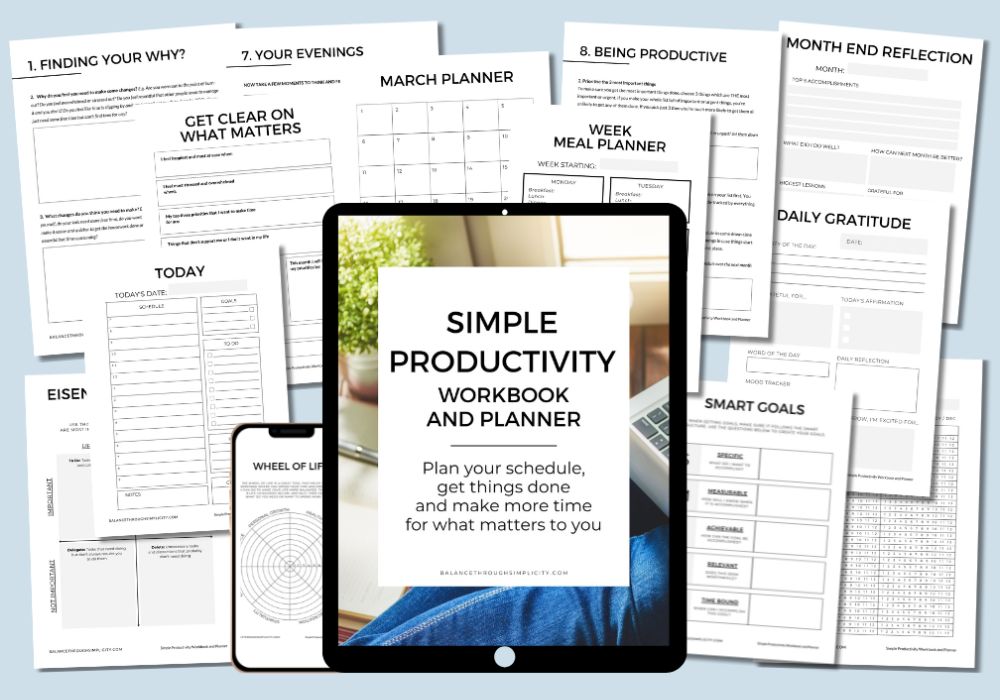
If you’d like some help putting these ideas into practice, my Simple Productivity Workbook and Planner is designed to help you simplify your schedule, prioritise what matters and feel more in control of your time.
This 100-page workbook includes practical exercises to help you understand where your time goes, clarify your priorities and build routines that work for your life, along with more than 60 printable planning pages, including to-do lists, daily and weekly planners, schedules and time-blocking templates.
You can choose the pages that work for you, print what you need and create a simple planning system of your own. It’s not about squeezing more into your day or trying to do everything. It’s about finding a calmer, more manageable way to organise what matters most.
Click here to learn more about Simple Productivity.
And over to you
An overwhelming to-do list isn’t necessarily a sign that you’re disorganised or that you’re not trying hard enough. Sometimes, it simply means you’ve taken on too much, your priorities have changed or you’ve been expecting yourself to do more than your time and energy realistically allow.
It’s easy to get caught up in everything we think we should be doing. We want to keep on top of the house, look after the people we love, do a good job at work, make time for ourselves and perhaps work towards a few personal goals along the way.
That’s a lot to carry.
So, if your to-do list feels endless right now, please don’t feel that you have to tackle it all today. You don’t need to catch up with every unfinished task or turn yourself into a productivity expert overnight.
Start by getting everything out of your head, deciding what still matters and choosing one small thing you can do next.
And if you have a task that’s been sitting on your list for years, perhaps today is the day to make a decision about it. You can do it, schedule it, delegate it or let it go.
Whatever you choose, you don’t have to keep carrying it around in your head.
Remember, progress doesn’t mean doing everything. Sometimes, it means deciding what matters, letting go of what doesn’t and making a little more room for the life you want to live.
Over to you: What’s one task that’s been lingering on your to-do list for far too long? Could you take one small step towards completing it today, or would you feel better about crossing it off altogether?
I’d love to hear how you get on.
A few more resources to help you simplify your life
If you’re looking for more practical ways to feel organised and less overwhelmed, you might also enjoy these articles:
- How to Use the Pomodoro Method to Declutter Your Home — learn how to break tasks into short, manageable sessions.
- The 2-Minute Decluttering Rule (Small Actions for Big Wins) — discover a simple way to deal with small tasks before they build up.
- 20 Time Management Tips to Simplify Your Life When You’re Busy — find more practical ways to make the most of your time.
- 10 Simple Steps to Plan a Calmer, More Organised Week — plan your week around what matters most.
- Why Done is Better Than Perfect: 7 Ways to Stop Holding Yourself Back
And if decluttering your home is another thing that’s been sitting on your to-do list, my Declutter Starter Kit can help you take things one step at a time, without feeling that you have to tackle everything at once.