
Why Am I So Overwhelmed All the Time? It Might Be a Capacity Problem, Not a Time Management Problem
If you’ve ever found yourself wondering, “Why am I so overwhelmed all the time?”, you’re not alone. Feeling overwhelmed isn’t always a sign that you’re bad at time management. Sometimes it’s a sign that you’re carrying too much, mentally, emotionally or physically, and it’s time to take a closer look at what’s filling your days.
ARE YOU FEELING OVERWHELMED?
Do you ever feel as though you’re constantly behind?
No matter how many lists you make, planners you buy or productivity tips you try, there’s always something waiting to be done. The laundry basket fills up again, emails keep arriving, the calendar gets busier and the mental load never seems to switch off.
Many people find themselves asking, why am I so overwhelmed all the time?
For a long time, I assumed that feeling overwhelmed meant I needed to manage my time better.
If only I planned more effectively. If only I was more organised. If only I could find the perfect routine.
But over the years, I’ve realised something important.
Sometimes overwhelm isn’t a time management problem at all.
Sometimes it’s simply a sign that we’re carrying too much.
Understanding the difference can help us stop blaming ourselves and start making changes that actually make life feel easier.
Why We Often Blame Our Time Management
When life feels chaotic, it’s tempting to assume we’re doing something wrong.
We tell ourselves we should be more productive, more organised or better at keeping on top of things. We look for planners, systems and strategies that promise to help us fit everything into our day.
The problem is that many of us are already doing a reasonable job of managing our time.
The real issue is that we’re trying to fit too much into the time available.
No amount of colour-coded scheduling can create extra hours in the day.
When we confuse overwhelm with poor time management, we end up focusing on the wrong solution.
Overwhelm Is Often About Capacity, Not Time
One of the biggest lessons I’ve learned is that capacity matters just as much as time.
Two people can have exactly the same number of hours available, but very different levels of physical, mental and emotional energy.
You might technically have enough time to do everything on your list, but if you’re tired, stressed, worried, distracted or emotionally drained, those tasks will naturally feel heavier.
This is one reason people often feel overwhelmed by life even when they seem organised on the surface.
It’s not necessarily that we’re managing our time badly.
It’s that our capacity has changed.
This is especially common during busy seasons of life, major transitions, periods of stress or times when we’re caring for other people.
Try this:
- Ask yourself whether you need better time management or more breathing room
- Notice which responsibilities are consuming the most mental energy
- Give yourself permission to adjust expectations during demanding seasons of life
When Everything Feels Urgent
One of the most difficult parts of overwhelm is that it makes everything feel equally important.
- The kitchen needs tidying
- You need to answer that email
- You should exercise
- You haven’t planned meals
- There’s paperwork waiting
- You’d like to spend more time with family
- You want to work towards your goals
When our minds are overloaded, we lose the ability to see priorities clearly.
Instead of focusing on what matters most, we feel pulled in multiple directions at once.
This creates the uncomfortable feeling that we’re constantly busy but never making progress.
If you’ve ever felt overwhelmed with too much to do, this may be exactly what’s happening.
Try this:
- Choose one priority for today instead of ten
- Ask yourself what truly matters this week rather than this hour
- Focus on completion rather than perfection
The Connection Between Clutter and Overwhelm
I’ve been writing and learning about decluttering for well over a decade and I’ve seen this pattern again and again.
Physical clutter creates visual reminders of unfinished decisions, postponed tasks and responsibilities.
Every pile of paperwork, overflowing cupboard or cluttered worktop can quietly demand attention.
The clutter itself isn’t always the problem.
The problem is the mental load it creates.
This is one reason decluttering often feels so powerful. It doesn’t just create more space in our homes. It creates more space in our minds too.
If you’re feeling overwhelmed, simplifying your environment can be a surprisingly effective place to start.
You might also enjoy reading my articles on how to declutter when you’re overwhelmed, creating a calmer home and reducing mental clutter, as they all support the same goal of lowering your mental load.
Try this:
- Clear one small surface today. Avoid big spaces and where lots of decisions are needed as these are the worst places to start decluttering
- Remove anything that immediately creates stress when you see it
- Focus on creating calm rather than achieving perfection
Why Doing Less Can Sometimes Be More Productive
We often assume the answer to overwhelm is becoming more efficient.
But sometimes the answer is doing less.
That doesn’t mean giving up on your goals or responsibilities.
It means becoming more intentional about what deserves your time, attention and energy.
The more commitments, possessions, obligations and expectations we carry, the harder it becomes to focus on what truly matters.
Intentional living isn’t about fitting more into your day.
It’s about deciding what belongs there in the first place.
Try this:
- Look at your commitments and identify one thing you could pause, delegate or remove
- Consider what is adding value to your life and what is simply adding pressure
- Leave some white space in your diary rather than filling every available hour

A Simple Tool to Help You Understand Where Your Time Is Going
If you’re feeling overwhelmed all the time, sometimes what you need isn’t another planner. What you really need is a chance to step back and understand how you’re spending your time in the first place.
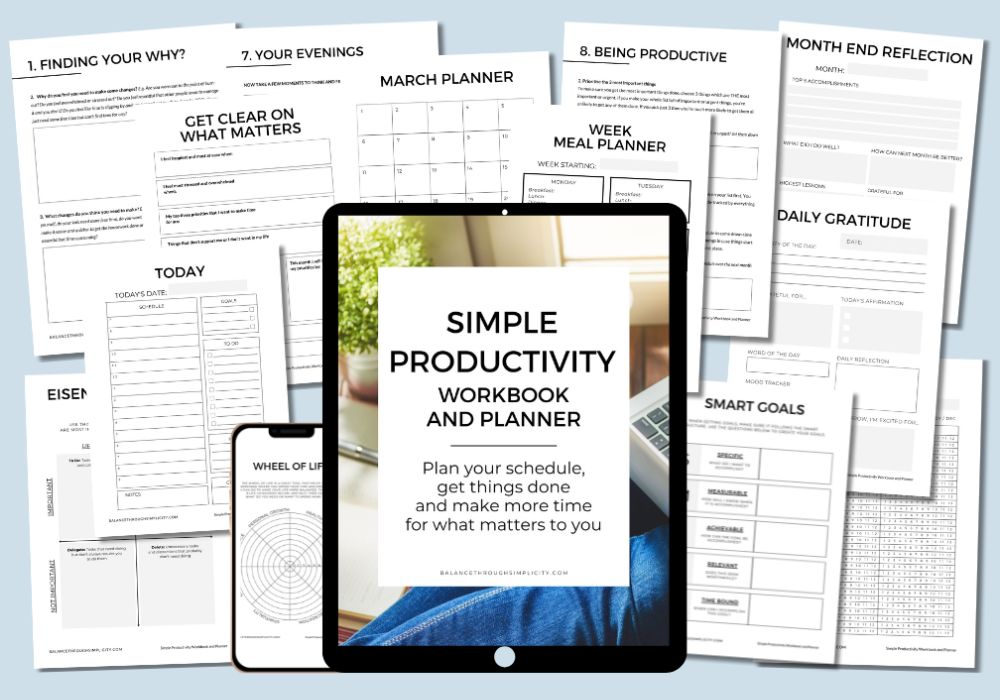
That’s exactly why I created my Simple Productivity Workbook and Planner.
Alongside practical planning pages, the workbook walks you through your daily routines, habits, priorities and commitments so you can see where your time, energy and attention are actually going. Rather than simply helping you fill in a calendar, it helps you think more intentionally about how you spend your days.
In terms of feeling overwhelmed, the aim of my workbook and planner is not to make you feel more like this. The workbook is there to guide, support and help you to explore your relationship with time and capacity, the planner pages are there for you to use – as, when and how you wish.
Many of us move through life on autopilot, saying yes to things automatically, filling our schedules without questioning them and wondering why we feel overwhelmed and stressed.
The workbook is designed to help you slow down, identify what matters most and create a more realistic and sustainable approach to managing your time.
Because sometimes the goal isn’t doing more.
It’s making sure you’re spending your time on the things that matter most.
Learn more about the Simple Productivity Workbook and Planner.
Overwhelm Is Information
Perhaps the most important thing to remember is that overwhelm isn’t a personal failure.
It’s information.
It’s your mind and body telling you that something needs attention.
- Maybe you need more rest
- Maybe you need fewer commitments
- Maybe you need clearer priorities
- Maybe you simply need to stop expecting yourself to do the work of three people
- Maybe you need to seek support from others including family, friends, colleagues or a professional
When we stop treating overwhelm as a sign that we’re failing and start treating it as useful information, we can respond with more compassion and more wisdom.
If you’ve been asking yourself, why am I so overwhelmed all the time?, perhaps the answer isn’t that you’re failing.
Perhaps it’s simply that life has become heavier than it needs to be.
Sometimes the most productive thing we can do is simplify.
And over time, those small acts of simplification can create a life that feels calmer, lighter and more manageable.
And over to you… Have you ever found yourself wondering why you’re so overwhelmed all the time?
I’d love to hear your thoughts in the comments below. What do you think contributes most to overwhelm in your own life, and what helps you feel calmer when everything starts to feel like too much?
Hi Nancy, thank you so much for your comment and I’m glad the article has helped you!
Great article Antonia, thank you. I am definitely overwhelmed and feel this article was written for me. Thank you for clarifying the difference, all this time I was thinking the problem was my time management. I believe what feels more overwhelming to me is managing my home, it is like another job apart from my actual job.
Thank you
Nancy