
What Is Digital Minimalism? 7 Simple Ways to Get Started
Discover what digital minimalism is and how adopting a simpler approach to technology can help you feel calmer, more focused and less overwhelmed. In this guide, I’ll explain the basics of digital minimalism and share seven practical ways to reduce digital clutter, create healthier tech habits and make technology work for you instead of against you.
DO YOU NEED A SIMPLER APPROACH TO TECHNOLOGY?
I have been decluttering, simplifying and exploring minimalism in my life for well over a decade and one of the most powerful benefits has been to create space and time for the things that really matter to me – my family, health, happiness and financial stability. In fact, this is just a few of the things I have more of by having less of others.
In this article I’m sharing some ideas around our digital world, the way in which it supports us and how, in the process, our busy brains, time and focus continue to be affected by technology.
Here are some statistics I came across recently:
- Average daily mobile screen time has been revised to 4 hours 37 minutes globally
- Social media users spend about 2.6 hours daily on mobile platforms.
- Across all generations, a majority (over 50%) acknowledge spending too much time on their phones, highlighting widespread digital dependence.
- Despite high awareness, the share actively reducing usage remains significantly lower, indicating a gap between recognition and behavior change.
- Source: https://sqmagazine.co.uk/mobile-phone-usage-statistics/
Technology is an incredible part of modern life. It helps us stay connected with family and friends, work more efficiently, shop from home and find information in seconds.
But it can also become… a lot. Notifications constantly compete for our attention. Our inboxes fill faster than we can empty them, and a few minutes on social media somehow turn into half an hour.
It’s no wonder more people are becoming interested in digital decluttering and digital minimalism as a way to create healthier, more intentional technology habits.
If you’ve ever felt mentally cluttered by technology, you’re certainly not alone.
That’s where digital minimalism comes in.
Despite what the name suggests, digital minimalism isn’t about giving up your smartphone or deleting every app you own. It’s simply about using technology more intentionally, so it supports your life instead of distracting from it.
In this article, I’ll explain what digital minimalism is and share seven simple ways you can start practising it without making dramatic changes.
What is digital minimalism?
Digital minimalism is a mindful approach to using technology more intentionally.
Instead of filling every spare moment with scrolling, checking notifications or switching between apps, it encourages you to choose the digital tools that genuinely add value to your life and reduce the ones that don’t.
I like to think of it as decluttering—but instead of clearing out cupboards and wardrobes, you’re clearing away digital distractions.
The goal isn’t to own less technology.
The goal is to create more space for the things that matter most. In fact, this is exactly what minimalism as a lifestyle is all about.
Why more people are embracing digital minimalism
Many of us don’t realise quite how much technology fills our day until we deliberately step back.
Phones, tablets, smart watches, laptops and televisions all compete for our attention. At the same time, we’re bombarded with emails, texts, alerts and notifications.
It’s no wonder so many people feel mentally tired.
Digital minimalism offers a gentler alternative.
Rather than asking, “How can I use more technology?”, it asks:
“How can technology better support the life I want to live?”
For me, that’s what simplifying is really about.
7 WAYS TO PRACTISE DIGITAL MINIMALISM IN YOUR OWN LIFE
If you’re curious about simplifying your use of technology, having a more intentional approach to using your phone or just want some simple ways to get started with digital minimalism, I hope you find the following ideas helpful…
1. Set healthy boundaries with your favourite apps
One of the simplest changes I’ve made is using the Screen Time settings on my phone.
I’ve set daily limits for apps like Facebook and Instagram because I know how easy it is to keep scrolling long after I’ve finished looking for what I originally opened the app to find.
When the timer reminds me that my time is up, I put my phone down and go and do something else instead. Sometimes I’ll read a few pages of a book, take the dog for a walk, make a cup of tea or simply get on with another task.
It’s a small change, but it’s helped me become much more aware of how I spend my time online.
Read more about creating social media boundaries to improve your life.
2. Make it a little harder to access distracting apps
Sometimes the easiest way to change a habit is to make it slightly less convenient.
In the past, I’ve experimented with removing social media apps from my phone altogether. If I wanted to check them, I had to go to my desktop computer, open a browser and log in.
That extra effort was often enough to make me stop and think, “Do I really need to check this right now?”
More often than not, the answer was no.
Read more about my thoughts on minimalism and social media.
3. Keep your phone out of reach
Another habit that’s made a surprising difference is where I keep my phone.
Instead of carrying it around the house with me, I usually leave it in one central place.
Because it’s not constantly within arm’s reach, I’m far less likely to pick it up out of habit.
It’s amazing how often we reach for our phones simply because they’re there.
Read more about how to do a digital detox to declutter your inbox and mind.
4. Turn off notifications you don’t need
Not every app needs your attention.
Take a few minutes to review your notification settings and ask yourself which alerts are genuinely helpful.
The fewer interruptions you have during the day, the easier it becomes to stay focused on what you’re doing.
Read more about some other ways to reduce distractions in your life.
5. Declutter your digital spaces
Just as physical clutter can make a home feel overwhelming, digital clutter can make technology feel stressful.
You could start by:
- deleting apps you no longer use
- unsubscribing from emails you never read
- organising your photos
- removing duplicate files
- tidying your desktop
- creating folders for important documents.
Little by little, everything becomes easier to find.
6. Create regular screen-free moments
You don’t have to avoid technology completely.
Instead, choose a few moments each day when you intentionally put your phone away.
Perhaps that’s during meals, while reading, when chatting with family or for the last hour before bed.
These small pockets of screen-free time can help you feel calmer and more present.
Read more about things I do before checking my phone each morning.
7. Remember that digital minimalism isn’t about perfection
This is probably the most important point of all.
Digital minimalism isn’t about following strict rules or never using social media again. Instead, it’s about making conscious choices.
Some days you’ll spend more time online than others, and that’s perfectly okay.
The aim is simply to make sure technology supports your life rather than taking it over.
Progress is always better than perfection.
The benefits of digital minimalism
As you begin making small changes, you may notice some unexpected benefits.
Many people find they:
- feel less overwhelmed
- improve their focus
- waste less time scrolling
- sleep better
- feel more present with family and friends
- enjoy hobbies again
- feel calmer throughout the day.
Often, it’s the smallest habits that make the biggest difference.
Frequently Asked Questions About Digital Minimalism
Here are some common questions around digital minimalism that you might be curious about yourself.
1. Is digital minimalism the same as reducing screen time?
Not quite. Reducing screen time can be part of digital minimalism, but the two aren’t exactly the same.
Digital minimalism is about being more intentional with technology. Instead of simply spending less time on your phone, you choose which digital tools genuinely improve your life and let go of the habits that don’t. Sometimes that means less screen time, but it also means making the time you do spend online more purposeful.
2. Do I have to delete social media?
No. Digital minimalism isn’t an all-or-nothing approach.
If social media helps you stay in touch with friends, learn something new or brings you joy, there’s no reason you can’t keep using it. The aim is to use it intentionally, rather than scrolling out of habit or feeling as though you have to check it constantly.
3. Is digital minimalism only for younger people?
Not at all.
People of all ages can benefit from a simpler approach to technology. Whether you’re overwhelmed by emails, distracted by notifications or simply want to spend more time enjoying everyday life, digital minimalism can help you create healthier habits that work for you.
4. What’s the difference between digital clutter and digital minimalism?
Digital clutter is the collection of unnecessary files, apps, emails, photos and digital distractions that build up over time.
Digital minimalism is the mindset that helps you decide what to keep and what to let go. Think of digital clutter as the problem, and digital minimalism as one way to solve it.
5. Where should I start if I feel overwhelmed?
Start with one small change.
Turn off a few unnecessary notifications. Unsubscribe from emails you never read. Set a daily limit for one social media app or leave your phone in another room while you eat dinner.
Small, consistent habits are much easier to maintain than trying to change everything at once.
6. Can digital minimalism really make a difference?
In my experience, yes.
I’ve found that setting screen time limits, keeping my phone in one place around the house and making it slightly less convenient to access social media has helped me become much more aware of how often I reached for my phone without thinking.
Those small changes haven’t stopped me using technology—they’ve simply helped me use it more intentionally. And for me, that’s what digital minimalism is really about.
7. Is digital minimalism worth it?
If you’ve ever felt distracted, overwhelmed or constantly drawn back to your phone, digital minimalism can be well worth trying. It isn’t about using less technology for the sake of it—it’s about using technology in a way that supports your wellbeing, relationships and daily life.
CONCLUSION
Technology certainly isn’t the enemy. In fact, you wouldn’t be reading this article if it weren’t for technology! The aim isn’t to reject it, but to use it in ways that genuinely add value to your life.
Digital minimalism simply encourages us to use technology with intention instead of habit.
You don’t have to make huge changes overnight. Start with one small habit. Those tiny changes soon add up to a calmer mind, more focused days and a simpler, more balanced life.
READY FOR MORE DECLUTTERING AND SIMPLIFYING?
If you’re also working on simplifying your home, remember that digital clutter is just one piece of the puzzle.
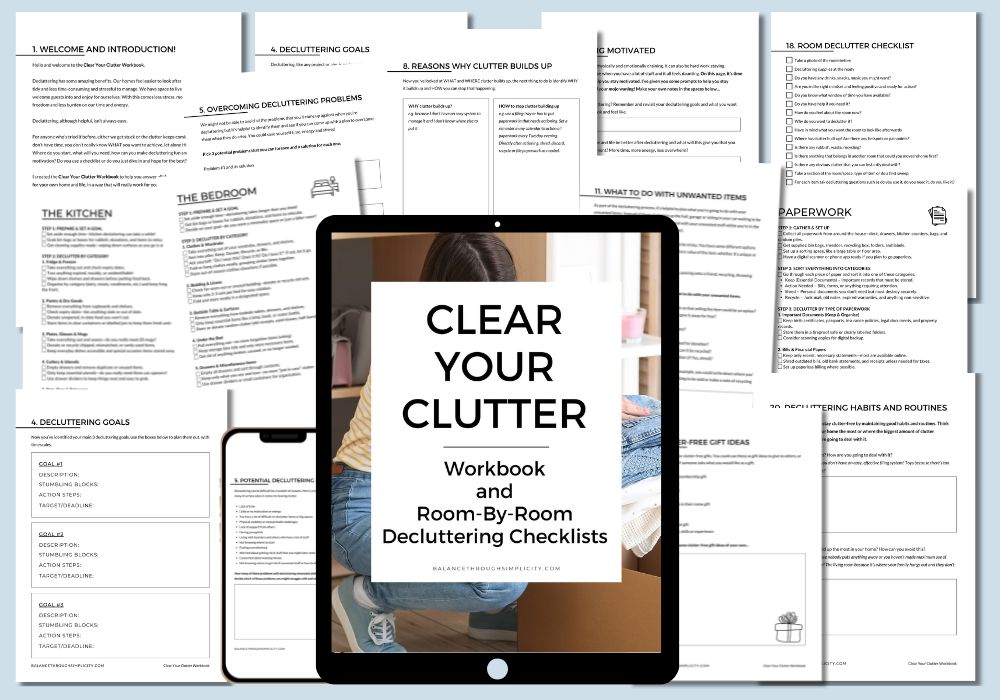
My Clear Your Clutter Workbook is designed to help you declutter every area of your home with simple, step-by-step guidance and really handy decluttering checklists for each room in your home.
I’ve also included sections on decluttering your office, desk and computer, so if you’re looking to simplify your digital life as well as your home, you’ll find plenty of practical ideas there too.
I hope it can help you create a home that feels calmer, more organised and easier to enjoy.
Learn more about the Clear Your Clutter Workbook.
And over to you… I’d love to hear from you. Have you tried digital minimalism, or is this a new idea for you?
Which of these seven tips do you think would make the biggest difference in your own life?
Share your thoughts and experiences in the comments below. Your ideas might inspire someone else who’s looking for a simpler approach to technology.
The goal of digital minimalism isn’t to spend less time with technology. It’s to spend more time on the people, activities and moments that matter most.
Here are some more articles which might help you explore that idea even more…
- How to Prioritise Connection Over Consumption
- 20 Things That Waste Time During The Day and Clutter Your Schedule and Mind
- Simple Ways Minimalism Can Help Improve Your Time Management
- 10 Productive Things to Do on Your Phone
- ‘Digital Minimalism‘ by Cal Newport. This book is not about rejecting technology but intentionally using it to support your goals and values. Well worth reading if digital minimalism is of interest to you.