
How to Declutter Books When You Struggle to Let Them Go
If you’re wondering how to declutter books without getting rid of the ones you love, you’re not alone. Books can be surprisingly emotional possessions, but with a few simple questions and a little breathing space, you can create a collection that works for you.
HOW TO DECLUTTER BOOKS
The easiest way to declutter books is to keep the books you genuinely love, use or want to read, and let go of those you’ve finished with, no longer enjoy or are only keeping out of guilt. If you give your books a defined amount of space, you’ll have a simple limit that makes deciding what to keep much easier.
I love the benefits of decluttering my home but I have a bit of a complicated relationship with books.
I love them. I love the look of them on a shelf, the feel of them in my hands and the anticipation of opening one that I’ve been looking forward to reading. I’m also a great fan of audiobooks, and there are plenty of times when listening to a book while I’m walking or doing something around the house is the easiest way for me to fit reading into my life.
But sometimes, for me, there’s still nothing quite like holding a physical book in your hands and turning the pages.
So, are books clutter?
Well, they can be. But I don’t think books automatically become clutter simply because you have a lot of them.
I like to think of books as old friends.
Some are friends I see regularly. Some were important to me during a particular season of my life. And some are friends I haven’t seen for years but still feel very fondly towards.
I’ve even kept a few books that belonged to my mum. They’re very old copies, and I love the smell of them. You don’t get that from reading a book off a screen or listening to the audio version.
They remind me of watching my mum read when I was younger. She was a real bookworm, and those particular books have a sentimental value that has nothing to do with whether I am ever likely to read them.
That’s important because decluttering books isn’t always as straightforward as decluttering a kitchen cupboard.
Books can carry memories, aspirations, comfort and identity.
And that means it’s perfectly understandable if you’re finding it difficult to decide what stays and what goes.
But if you’ve accumulated a lot of books and your shelves are becoming overcrowded, there are ways to declutter your book collection without getting rid of everything you love.
Why declutter your books?
The aim of decluttering books isn’t necessarily to have an empty bookshelf or to own as few books as possible.
It’s about making space for the books that matter to you.
When you have fewer books, it’s often much easier to find the one you’re looking for.
You can see what you actually own. You aren’t constantly moving piles around to get to something underneath. Your shelves have room to breathe.
And perhaps most importantly, you’re less likely to feel that subtle sense of “I really ought to read all these books” every time you look at them.
I’ve gone through different seasons of life where I’ve either loved reading or become frustrated by it because I simply haven’t had the time.
I usually have a list on my phone of books I want to read. And when that list grows while my physical bookshelves are already full, I have to remind myself that owning a book isn’t the same thing as having to read it.
Your books should support your life, not give you another list of things you feel you ought to do or be the sort of person your fantasy self thinks you should be.
How to declutter books
If you’re ready to declutter your books, don’t feel that you have to make hundreds of decisions in one go.
Start with the books you already know you’re ready to let go of, and then work through the harder decisions gradually.
1. Gather all your books together
If possible, bring your books together so you can see what you actually have.
This might mean taking books from different bookshelves, bedside tables, piles around the house and anywhere else you’ve been storing them.
Seeing your collection as a whole can be surprisingly helpful.
You might discover that you’ve got several books on the same subject, multiple books you’ve completely forgotten about, or books you’ve been moving from one room to another without ever really deciding where they belong.
You don’t necessarily have to take every single book off the shelf if that feels overwhelming. You can work shelf by shelf.
The important thing is to get an honest picture of your collection.
2. Start with the easy decisions
Don’t begin with the book you inherited from your grandmother or the one that reminds you of your first job.
Start with the easy ones.
Ask yourself:
- Have I read this?
- Would I read it again?
- Do I still want to read it?
- Do I enjoy having it?
- Is it useful to me?
- Would I choose to buy this book again today?
- Am I keeping it because I genuinely want it, or because I feel I should?
You’ll probably find some very easy decisions.
A book you’ve read, didn’t particularly enjoy and know you’ll never read again doesn’t need a lengthy deliberation.
3. Let go of books you’ve already read
One of the easiest places to start is with books you’ve finished and don’t intend to read again.
Sometimes we keep a book because we enjoyed it.
That’s lovely.
But enjoying a book doesn’t necessarily mean you need to keep the physical copy forever.
If you’ve read it, loved it and know you’ll happily pass it on, there’s nothing wrong with letting it go.
Someone else might discover their new favourite book because you decided you didn’t need to keep yours.
Of course, if it’s one of those books you know you’ll reread, keep it.
Your aim isn’t to follow somebody else’s rules about how many books you should own. It’s to create a collection that works for you.
4. Give yourself permission not to finish a book
This one has taken me a while to learn.
You do not have to finish every book you start.
If you’re partway through a book and you’re not enjoying it, you can stop.
I have moved past the idea that I need to force myself through a book simply because I’ve already started it.
Life is too short, and my time and mental energy are too limited.
I’d rather spend the time I have genuinely enjoying a book than pushing myself to finish something I’m not interested in.
And if you’re keeping an unfinished book because you feel guilty about not finishing it, ask yourself whether you’re realistically going to pick it up again.
If the answer is no, let it go.
Stopping halfway through a book isn’t failure. Sometimes it’s simply recognising that a particular book isn’t right for you at this particular point in your life.
Sometimes, even, our stuff can hold us back in life.
5. Look at the books you haven’t read yet
This can be a slightly trickier category.
There’s something very appealing about owning a shelf full of books you’re looking forward to reading.
But be honest about your intentions.
If you’ve owned a book for five years and haven’t read it, do you genuinely still want to?
Or are you keeping it because you like the idea of being the person who reads that book?
Ask yourself:
“If I didn’t already own this book, would I choose to buy it today?”
If you would, keep it.
If you wouldn’t, that’s useful information.
You can always add the title to your reading list instead. You don’t need to keep a physical book in your home simply because you might want to read it one day.
You can declutter your stuff without decluttering your memories too.
6. Don’t keep books because you feel guilty
This is particularly important if you have books that were gifts.
Someone giving you a book was an act of kindness.
It doesn’t mean you’ve entered into a lifelong contract to keep it.
- Perhaps you read it and didn’t like it.
- Perhaps you’ve changed your interests.
- Perhaps you simply have too many books.
You can appreciate the thought behind a gift while recognising that the physical object no longer needs to stay with you.
The same applies to books you bought because you thought you should read them.
You don’t have to turn your bookshelf into a monument to all the things you once intended to do.
7. Keep sentimental books intentionally
This is where I think it’s important to make room for sentiment.
Some books aren’t there because they’re useful.
They’re there because they mean something.
I have those old books that belonged to my mum. I love them, even though I could probably find a newer copy of the same book very easily.
The smell of those old pages takes me straight back to watching my mum read.
Those books aren’t clutter to me.
They’re memories.
If you have books like this, keep them.
But keep them intentionally.
You don’t have to apply a ruthless decluttering rule to something that genuinely brings you joy or connects you to someone you love.
The question isn’t simply “Have I read this?”
Sometimes the better question is:
“Does this book have a meaningful place in my life?”
8. Think about the container concept
If you’re struggling to know when you’ve decluttered enough books, try using the container concept.
Instead of deciding that you should own a certain number of books, decide how much physical space you’re prepared to give them.
Perhaps you have:
- One large bookcase.
- Two shelves in a cupboard.
- A small bookshelf in your bedroom.
- One shelf for cookbooks and another for everything else.
That space becomes your container.
Your job isn’t to squeeze as many books as possible into it.
Your job is to choose which books deserve the space available.
This can make decluttering books much easier because you’re no longer asking:
“Which books am I allowed to get rid of?”
You’re asking:
“Which books do I most want to keep within the space I’ve chosen?”
If you have more books than will comfortably fit, that’s your signal to declutter.
And if your collection fits comfortably and you love all your books, perhaps you don’t need to declutter at all.
How many books should you keep?
There isn’t a magic number.
You don’t need to own 20 books because someone else says that’s enough.
You don’t need to reduce your collection to 10 books to qualify as a minimalist.
And you certainly don’t need to get rid of books you love simply because you have more books than somebody else thinks you should.
Instead, think about:
- How much space you have.
- How often you read.
- Whether you reread your books.
- Whether your collection reflects your current interests.
- Whether your books are easy to find.
- Whether your books bring you pleasure or create stress.
Your ideal number of books is the number that works for you.
What about Kindle books and audiobooks?
Digital books can be a useful alternative if you’re trying to reduce the physical space your reading habit takes up.
I enjoy audiobooks, particularly when I don’t have the time to sit down with a physical book.
Kindle books can also be a good option if you want to read something without adding another physical book to your shelves.
But I don’t think digital books need to replace physical books completely.
For me, sometimes there is simply nothing like holding a physical book and turning the pages.
So think about what works for you.
You might decide that:
- Books you want to reread are worth keeping physically.
- Books you’re unlikely to read again can be borrowed from the library.
- New books can be bought digitally.
- Audiobooks work well for books you want to enjoy while walking or doing other things.
- Physical copies are reserved for books you particularly love.
There isn’t one right way to read.
How to organise your books after decluttering
Once you’ve reduced your collection, you can decide how you’d like to organise the books you’ve kept.
And this is where having fewer books can make such a difference.
It’s much easier to create an organised bookshelf when you’re not trying to cram 300 books onto a shelf designed for 150.
Here are a few approaches you could try.
Organise books by author
Alphabetical order by author is a simple option, particularly if you have a lot of books.
It makes finding a particular book straightforward and works especially well if you tend to read particular authors.
Organise books by category
You could group books according to subject, such as:
- Fiction
- Personal development
- Cooking
- Travel
- History
- Business
- Parenting
- Health and wellbeing
This can make it easier to find something when you’re looking for a particular type of book.
Organise books by colour
Some people love organising books by colour.
It’s visually pleasing and can make a bookshelf feel more like part of your home’s decor.
It isn’t necessarily the most practical method if you’re constantly trying to remember whether a particular book has a blue or green spine, but if you love the way it looks, that’s a perfectly good reason to do it.
Organise books by how much you love them
This is one of my favourite ideas.
You could have your everyday favourites within easy reach, while less frequently used books go on higher shelves or into storage.
You might even create a small shelf for your absolute favourites — the books you know you’ll return to again and again.
What should you do with books you’re decluttering?
Once you’ve decided which books you’re ready to let go of, try to give them another life where possible.
Depending on their condition, you could:
- Donate them to a charity shop.
- Give them to friends or family.
- Pass them on through a community book exchange.
- Donate them to a school or community organisation where appropriate.
- Sell valuable or sought-after books.
- Take them to a local library if they accept donations.
Try not to let the “what do I do with these?” question stop you from making the decision.
You can work that part out afterwards.
Here is a guide which might be helpful on what to do with unwanted items after decluttering.
A simple book decluttering checklist
If you’re standing in front of an overflowing bookshelf and don’t know where to begin, use these questions:
Keep it if:
- You love it.
- You regularly reread it.
- You genuinely intend to read it.
- It’s useful to you.
- It has meaningful sentimental value.
- You would choose to buy it again today.
Let it go if:
- You’ve read it and don’t want to read it again.
- You didn’t enjoy it.
- You’re keeping it because you feel guilty.
- You’ve lost interest in the subject.
- You’ve owned it for years without reading it and no longer really want to.
- You can easily access the information elsewhere.
- It’s taking up space you would rather use for something else.
And remember: “I don’t want this anymore” is a perfectly good reason to let a book go.
You don’t need a more important justification.
Decluttering books isn’t about owning fewer for the sake of it
I think this is the part that’s easiest to forget.
Decluttering isn’t about reaching some imaginary level of minimalism where your shelves are almost empty.
It’s about making your home work better for you.
For me, that means keeping the books I genuinely love. It means keeping some of my mum’s old books because they connect me to her. It means letting go of books I’ve finished and don’t want to read again.
It also means accepting that my reading habits change.
There are times when I read constantly.
There are times when I’m too busy and frustrated that I don’t have more time to read.
There are times when my reading list grows faster than I can get through it.
That’s life.
And perhaps that’s why I don’t think we need rigid rules about books.
Instead, ask yourself whether the books you own are supporting the life you’re living now.
If they are, enjoy them.
Read them. Reread them. Keep them.
And if your bookshelves are full of books that belong to a different version of you, books you’ve finished with, books you’re keeping out of guilt, or books you no longer even want to read, give yourself permission to let some of them go.
You might be surprised by how much easier it is to find the books you really love once there’s a little more space around them.
WANT TO CLEAR YOUR CLUTTER TODAY?
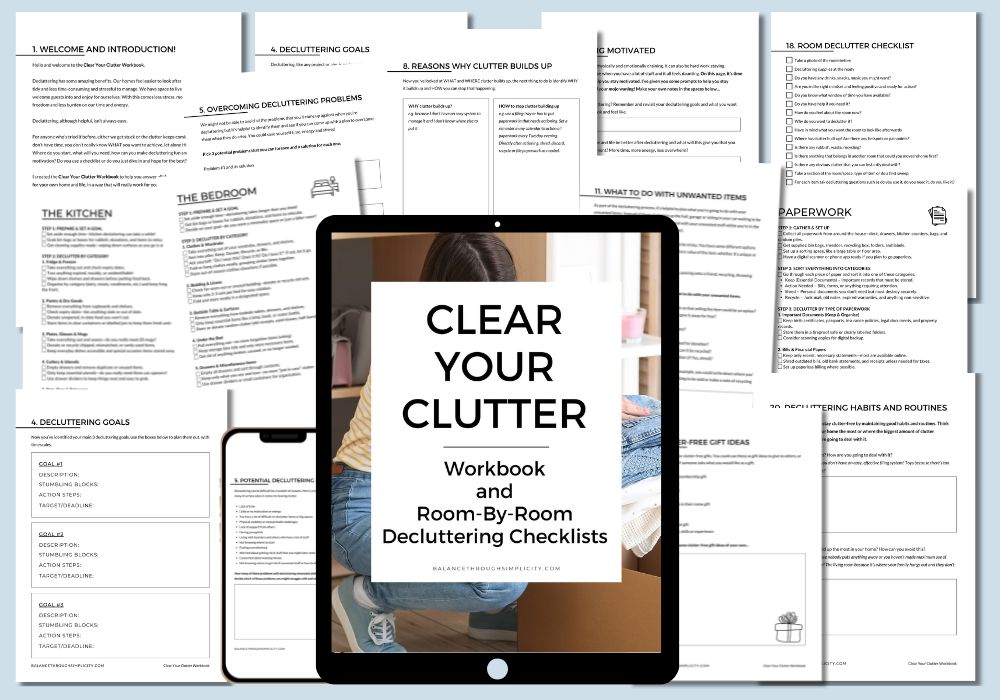
If you’re ready to tackle more than just your books, my Clear Your Clutter workbook can help you work through the decluttering process step by step.
It includes a dedicated section and printable checklist on decluttering books, along with practical guidance to help you clear the clutter from other areas of your home too — so you can create more space, calm and breathing room in your everyday life.
Click here to learn more about the Clear Your Clutter Workbook.
Hi Nancy, you’re so welcome. I’m glad you enjoyed the article and hope you can find some tips to help you. Thank you for reading.
What an interesting article Antonia, thank you. I have lots of books and it is a category I found very difficult to declutter.
Thank you,
Nancy