
5 Simple Daily Practices That Help Me Feel More Grounded
Looking after your mental health doesn’t have to involve complicated routines. Here are five simple daily practices to support better mental health. I return to them every day to reduce stress, restore calm and help me show up as the best version of myself, even when life feels busy.
WHY LOOKING AFTER MY MENTAL HEALTH MATTERS
There have been seasons in my life when decluttering my mind and looking after my mental health has felt easy, and others when it’s taken much more intention.
Like many people, life can sometimes feel as though it’s resting on my shoulders. My children are teenagers, I work two jobs, there are endless responsibilities to juggle, and I often feel like I’m the glue that holds everything together. In many ways, it’s a privilege. I love my family, I’m grateful for my work and I know how fortunate I am.
But if I’m honest, it can also be exhausting.
Over the years I’ve realised something important: prioritising my mental health isn’t selfish. It’s essential.
If I want to continue showing up for the people I love, making good decisions, enjoying the life I’m building and feeling like the best version of myself, I have to look after my own wellbeing first.
I’ve experimented with all sorts of self-care ideas over the years, but I always come back to the same handful of simple daily practices. None of them are complicated. None of them cost very much. Most only take a few minutes.
Yet together, they help restore calm to my mind, perspective to my thoughts and joy to my heart.
They’ve become non-negotiable parts of my day, and I genuinely look forward to them, however busy life gets and however long my to-do list might be.
I’m sharing them here in the hope that, if life feels busy or overwhelming for you too, they might offer a little comfort and encouragement.
Why simple daily mental health habits matter
When we’re stressed, it’s easy to think we need dramatic changes before we’ll feel better.
In reality, I’ve found it’s often the small things we do consistently that make the biggest difference.
A few quiet moments here and there can gently interrupt the cycle of rushing, worrying and reacting. They create space to breathe, think clearly and reconnect with ourselves before life carries us along again.
5 SIMPLE DAILY PRACTICES TO SUPPORT BETTER MENTAL HEALTH
Here are the five daily practices I keep coming back to.
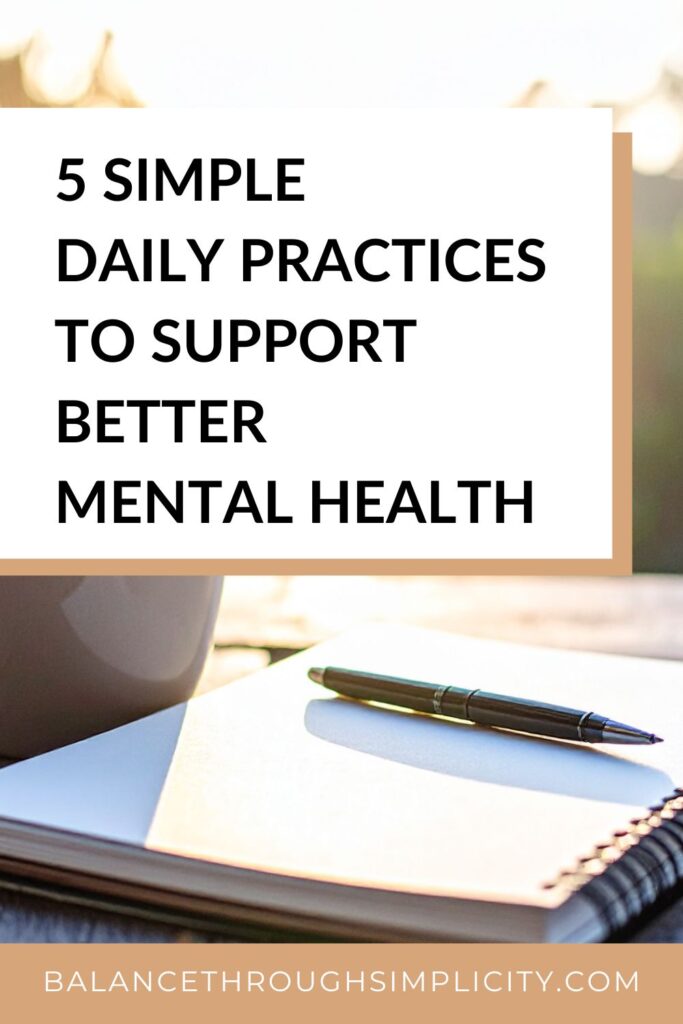
1. Journaling helps me untangle my thoughts
My journal has become one of my favourite places.
Some mornings I write pages. Other days it’s just a few sentences.
I don’t worry about grammar, neat handwriting or whether any of it makes sense. It’s simply somewhere to empty my mind.
When everything is swirling around in my head, writing it down somehow makes it feel more manageable. Problems become clearer, emotions become easier to understand and worries lose some of their power.
- Sometimes I write about what’s bothering me.
- Sometimes I write down what I’m grateful for.
- Sometimes I simply make a list of everything on my mind.
Whatever ends up on the page, I almost always finish feeling lighter than when I started.
You might enjoy these journaling tips for beginners to learn more about journaling as a self-care practice.
2. Walking clears my head
Walking has become one of the simplest ways I care for both my body and my mind.
Fresh air, movement and a change of scenery have a wonderful way of helping me reset.
I don’t always go on long countryside walks. Sometimes it’s just twenty minutes around the neighbourhood. Sometimes I listen to birdsong instead of a podcast. Sometimes I walk with the dog. Sometimes I simply notice the changing seasons.
When life feels overwhelming, movement reminds me that I don’t have to solve every problem immediately.
I simply need to keep taking one step at a time.
More often than not, I return home feeling calmer, more focused and ready to tackle whatever comes next.
3. I deliberately switch off my screens
Our phones are amazing tools, but they can also become endless sources of distraction, comparison and mental clutter.
I’ve noticed that the more time I spend scrolling, the more scattered my thoughts become.
That’s why I’ve become much more intentional about switching off screens.
In the evenings especially, I try to put my phone down before bed and resist the temptation to keep checking emails or social media “just one more time.”
Instead, I’ll read a book, tidy the kitchen slowly, make a cup of tea or simply sit quietly.
It’s amazing how much calmer my mind feels when I’m not constantly consuming more information.
Sometimes the best thing we can do for our mental health is simply create a little more space and better boundaries around our screentime.
4. I make time to connect with the people I love
When life gets busy, relationships can easily become another task squeezed into the diary.
I’ve learned that meaningful connection deserves to be protected.
That might be chatting with my husband after dinner, texting a friend, phoning a family member or simply sitting with my children and asking how their day has been.
These moments don’t need to be long. What matters is being present.
Real conversations remind me that I’m not carrying everything alone. They help me laugh, gain perspective and remember what really matters.
Even on difficult days, connection has a remarkable way of lifting my spirits.
5. I find moments of silence and reflection
Life is noisy, particularly if you’re a Highly Sensitive Person like me!
Notifications, conversations, responsibilities and endless to-do lists compete for our attention every minute of the day.
I’ve realised that if I don’t intentionally create quiet moments, they rarely happen on their own.
- Sometimes that means sitting in the garden for five minutes before everyone wakes up.
- Sometimes it’s enjoying my morning cup of tea without reaching for my phone.
- Sometimes it’s simply closing my eyes, taking a few deep breaths and letting my thoughts settle.
Those small pockets of silence help me reconnect with myself. They remind me that I don’t always need to be doing something.
Sometimes being still is exactly what I need.
These aren’t complicated—but they’ve changed so much
None of these habits are revolutionary. In fact, they’re wonderfully ordinary but that’s exactly why they’ve lasted.
I’ve learned that supporting better mental health doesn’t always require hours of spare time, expensive retreats or a complete life overhaul.
Often, it’s found in the quiet decisions we make every single day.
- Writing in a journal.
- Going for a walk.
- Putting the phone away.
- Talking with someone we love.
- Allowing ourselves a few moments of silence.
These simple daily practices have helped me navigate stressful seasons, busy family life and the demands of work while feeling more grounded, calmer and more like myself.
Of course, everyone is different, and what supports one person may not support another. If you’re struggling with your mental health or finding things difficult to manage, it’s important to reach out to your GP or a qualified mental health professional. These daily habits aren’t a substitute for professional support, but they can become gentle anchors that help support your overall wellbeing alongside it.
CONCLUSION
Self-care for your body and mind is essential.
If life feels especially busy right now, perhaps don’t try to change everything at once. Just choose one small practice. Give yourself permission to protect a few minutes each day.
You deserve that care just as much as everyone else in your life does. Sometimes it’s the smallest daily habits that quietly make the biggest difference.
WANT TO DIVE DEEPER?
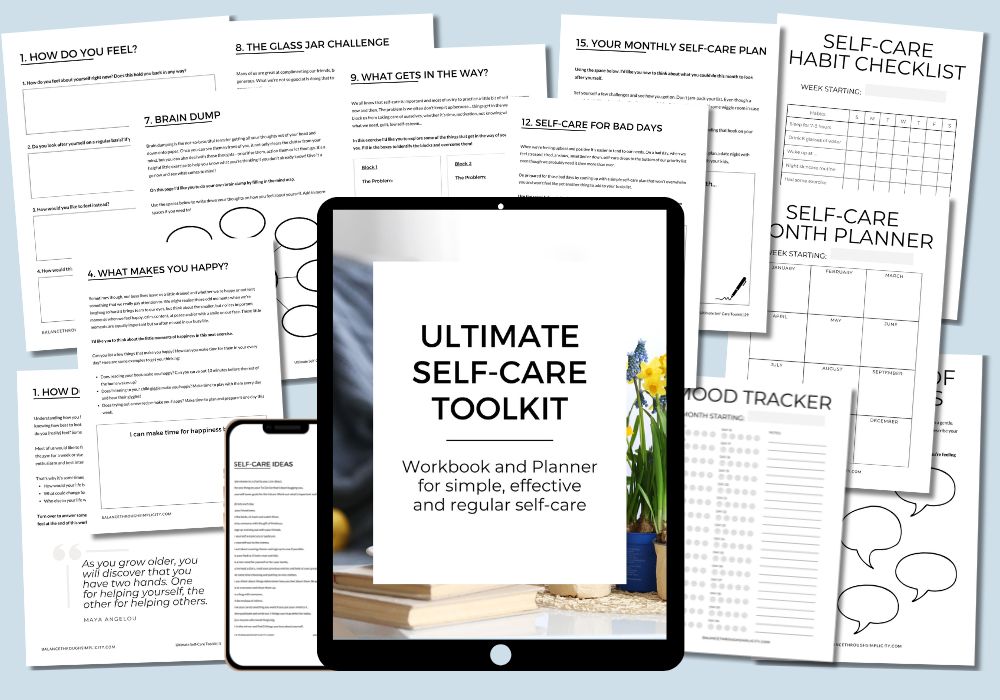
If you’re looking for more gentle ways to prioritise your wellbeing, my Ultimate Self-Care Toolkit is designed to help you create simple, sustainable self-care habits that fit into real life.
Packed with practical worksheets, thoughtful prompts, planners and exercises, it will help you reduce overwhelm, manage stress, nurture your mental and emotional wellbeing, and make more time for the things that truly matter.
Whether you need a little encouragement to slow down or you’re ready to build a calmer, more balanced lifestyle, the Ultimate Self-Care Toolkit offers practical support to help you take care of yourself—one small step at a time.
Learn more about the Self-Care Toolkit.
READ THESE NEXT…
If you’d like to read more of my articles on this topic, here are some suggestions:
- How to Create a Life That Supports You (Instead of Drains You)
- 10 Mindful Habits to Reduce Daily Stress and Declutter Your Mind
- Minimalism and Mental Health: 7 Ways Minimalism Supports Better Mental Health
- How Journaling Helps Simplify Your Life
- 10 Ways to Avoid Wearing Busy as a Badge of Honour
- 5 Everyday Habits That Make Life Feel Simpler