Swedish Death Cleaning: What It Is and How to Use This Simple Decluttering Method
Swedish death cleaning is a gentle way to declutter your home, keep what matters and make life easier for the people you love. Despite its name, it’s really about living more simply and intentionally.
SWEDISH DEATH CLEANING
Swedish death cleaning is a way of thoughtfully decluttering your possessions so that you keep what matters, let go of what you no longer need, and avoid leaving an overwhelming amount for someone else to deal with later. Despite its name, it isn’t really about death at all; it’s about living with less clutter, more intention and greater consideration for the people you love.
If you’ve heard the phrase Swedish death cleaning before, you might have wondered what on earth it means. The name sounds rather dramatic, doesn’t it?
But the idea behind it is actually much gentler.
Swedish death cleaning is about looking at the things you own and asking yourself whether you really need, use or love them — and whether someone else would be left with the job of sorting through them if you weren’t here to do it yourself.
I have a very personal reason for understanding why this matters.
When my dad died, my mum was not only dealing with the enormous grief of losing her husband. She also had to deal with all his belongings.
My dad was a hoarder, and over the years he’d accumulated a huge amount of stuff. After he retired, he’d built up his own little carpentry and furniture-making business, so there were tools, DIY equipment and all sorts of associated bits and pieces.
Some of the equipment was enormous.
There were big pieces of machinery that my mum didn’t know how to use, didn’t need and didn’t know how to get rid of. There were boxes of things whose purpose she didn’t understand and possessions that had clearly been important to my dad but weren’t useful to her.
It was stressful at a time when she was already navigating grief.
Eventually, she worked her way through it all. But I think the experience stayed with her.
After she’d managed to deal with my dad’s possessions, she decided that she didn’t want to leave me with an equally overwhelming amount of stuff to deal with when she died.
And I think that’s where Swedish death cleaning can be particularly powerful.
It isn’t about being morbid.
It’s about being considerate.
Further Reading: Decluttering After Bereavement: 7 Ways to Declutter After Losing Someone You Love
What is Swedish death cleaning?
Swedish death cleaning is a decluttering approach that encourages you to think carefully about the possessions you own and what will happen to them in the future.
The idea was popularised by Swedish author Margareta Magnusson in her book The Gentle Art of Swedish Death Cleaning.
At its heart is a simple question:
“What will happen to all this stuff when I’m no longer here?”
That might sound rather stark, but it can actually be a liberating question.
Instead of endlessly accumulating things because we have space for them, we start to think about what deserves a place in our homes.
We can ask ourselves:
- Do I use this?
- Do I love it?
- Does it have genuine sentimental value?
- Would someone else know what to do with it?
- Am I keeping it because I want it, or because I feel I should?
- If I were moving house, would I take it with me?
- Would I want someone else to have to sort through this?
The purpose isn’t to get rid of everything.
It’s to become more intentional about what we keep.
Further Reading: 7 Ways to Start Decluttering When You Have a Lifetime of Stuff
Why is it called Swedish Death Cleaning?
The name comes from the idea that you can make things easier for the people you leave behind by sorting through your possessions while you’re still able to do so.
And although the phrase includes the word death, I think it’s helpful to look beyond the name.
This isn’t really about thinking about dying.
It’s about thinking about living.
It’s about looking around your home and deciding whether the things you’ve accumulated still belong in the life you’re living today.
It’s also about kindness.
If you’ve ever had to clear the belongings of someone you love, you’ll know that it can be emotionally and practically exhausting.
Sometimes you’re grieving while simultaneously having to make hundreds of decisions.
- What is this?
- Should I keep it?
- Would they have wanted me to keep it?
- Where can I take it?
- Can I sell it?
- Can I donate it?
- How do I dispose of it?
Those decisions can become an enormous burden.
Swedish death cleaning offers a way of reducing that burden before it ever becomes somebody else’s responsibility.
Further Reading: 7 Reasons Why Decluttering Now Could Be One of the Kindest Gifts You Leave Your Children
Swedish death cleaning isn’t just for older people
This is one of the things I like about the underlying idea.
You don’t have to be elderly or facing the end of your life to use Swedish death cleaning principles.
You can simply use them as another way of thinking about your possessions.
- Perhaps you’ve accumulated things over twenty or thirty years.
- Perhaps you’ve moved house several times but never really decluttered between moves.
- Perhaps your children have grown up and you’ve still got cupboards full of things from when they were small.
- Perhaps you’ve inherited possessions from your parents.
Or perhaps you’ve simply reached the point where you look around your home and think:
“How did we end up with all this stuff?”
You don’t need a dramatic reason to start simplifying.
You can simply decide that you’d like to live with less.
How to start Swedish death cleaning
You don’t need to empty your entire house and create piles all over the floor.
In fact, if you find decluttering overwhelming, I’d recommend starting much smaller.
Choose one cupboard, one drawer or one category of possessions.
Then work through it thoughtfully.
1. Start with the easy things
Don’t begin with your most sentimental possessions.
Start with things you already know you don’t need.
Look for:
- Broken items you’re never going to repair.
- Duplicates.
- Clothes you never wear.
- Out-of-date paperwork.
- Unused kitchen gadgets.
- Things you’ve been keeping “just in case”.
- Items you don’t even remember owning.
These decisions will help you build momentum without immediately confronting the emotionally difficult things.
2. Ask whether you would choose to keep it today
We accumulate possessions gradually.
Something comes into our home because we need it, someone gives it to us, we buy it because we like it or we think it might be useful.
Then it stays.
And stays.
And stays.
Years later, we’re still storing it without ever questioning whether it belongs in our lives.
So ask yourself:
“If I didn’t already own this, would I choose to bring it into my home today?”
If the answer is no, that’s worth paying attention to.
You don’t have to get rid of everything you wouldn’t buy again, but it’s a useful question when you’re struggling to decide.
3. Think about the people you love
This is at the heart of Swedish death cleaning.
Imagine someone else having to sort through your belongings.
- Would they know what things are?
- Would they know what is valuable?
- Would they understand why something is important to you?
- Would they have to make hundreds of decisions about things you could easily decide for yourself now?
My mum’s experience after my dad died made this particularly real for our family.
She didn’t want me to have to deal with what she’d been left with.
That didn’t mean she suddenly became a minimalist or threw away everything she owned.
It simply meant that she became more thoughtful about what she accumulated and what she kept.
4. Deal with the things nobody else would want
This is a really useful part of the Swedish death cleaning philosophy.
There are often things in our homes that are difficult to dispose of.
Perhaps you have:
- Old chemicals or paint.
- Broken electrical equipment.
- Specialist tools.
- Large pieces of machinery.
- Boxes of cables.
- Old computers.
- Unwanted collections.
- Bulky furniture.
- Hobby equipment.
- Things that have particular disposal requirements.
You might know exactly what these things are.
Someone else may not.
And if you leave them behind, they may have to work out what to do with them at precisely the time when they’re least emotionally equipped to deal with it.
This doesn’t mean you need to dispose of everything immediately.
But if there’s something particularly awkward, bulky or specialist, it can be kind to deal with it while you’re able to explain what it is and find the right way to pass it on, sell it, donate it or dispose of it.
5. Leave sentimental possessions until later
Not everything needs to be dealt with immediately.
In fact, I think this is one of the most important things to remember when you’re decluttering.
Sentimental possessions can be difficult because you’re not just deciding about an object.
You’re deciding about a memory.
That’s why I wouldn’t start your decluttering journey with old photographs, letters or possessions belonging to someone you love.
Deal with the easy things first.
Then, when you’re ready, you can give sentimental possessions the time and attention they deserve.
And sometimes you’ll decide to keep them.
That’s okay.
Swedish death cleaning isn’t about eliminating sentimentality from your home.
It’s about making conscious choices.
6. Create a “throw away” box
One idea associated with Swedish death cleaning is the concept of keeping a small collection of things that are personal to you and that you’d like to be discarded rather than passed on.
These might be things that have meaning to you but wouldn’t necessarily have meaning to anybody else.
It’s a useful reminder that not everything needs to become somebody else’s responsibility.
You can be thoughtful about what you leave behind without expecting another person to preserve everything that mattered to you.
7. Tell people about the things that matter
Decluttering can sometimes reveal things that you didn’t realise were important.
- Perhaps you have a piece of jewellery that belonged to your grandmother.
- Perhaps there’s a painting you’ve had for years.
- Perhaps there’s a particular book that has a special story attached to it.
Don’t assume that everyone else knows why you love something.
Tell them.
You might even decide to make a note about certain sentimental possessions so that the story doesn’t disappear when you do.
The object is only part of the memory.
The story behind it can be just as valuable.
What should you declutter first?
If you’re not sure where to start with Swedish death cleaning, I would choose the least emotional category you can think of.
For example:
- Broken or unusable items.
- Duplicates.
- Clothes you no longer wear.
- Unused kitchen equipment.
- Old paperwork.
- Hobby supplies you no longer use.
- Bulky items that are difficult to dispose of.
- Things you’ve been keeping “just in case”.
- Items you’ve completely forgotten about.
- Sentimental possessions.
- Items that potentially make your home unsafe as your needs change.
You don’t need to work through the list in one weekend.
Choose one category and see how you get on.
What about things you might use one day?
“Just in case” is one of the most powerful phrases in a cluttered home.
Sometimes keeping something for a future possibility makes perfect sense.
But sometimes we’re keeping things for a future version of ourselves who may never arrive.
Ask yourself:
“How likely am I really to use this?”
And:
“If I needed this in the future, could I borrow, hire or replace it?”
You don’t have to become ruthless.
You’re simply checking whether the space and responsibility of keeping something is worth it.
What about family heirlooms?
This can be particularly complicated.
You might have inherited possessions because you assumed they were important to your family.
But you don’t have to keep every family possession simply because it has been passed down to you.
Choose the things that genuinely mean something.
- Perhaps it’s an old photograph.
- A piece of jewellery.
- A favourite recipe book.
- A chair that reminds you of your grandparents.
- Or, in my case, some of my mum’s old books.
The fact that something belonged to someone you love doesn’t automatically mean you need to keep everything they owned.
Keep the memories you value, not necessarily every object connected to them.
Swedish death cleaning and living more simply
Although Swedish death cleaning is often presented as a method for dealing with possessions towards the end of life, I think there’s something useful here for all of us.
It encourages us to question the constant accumulation of stuff.
- We buy something.
- We find somewhere to store it.
- We forget about it.
- We buy something else.
- Eventually, our homes become full of things that require our attention, our storage space and sometimes our guilt.
What if we interrupted that cycle?
What if we became a little more intentional about what comes into our homes in the first place?
And what if we regularly asked ourselves whether the things we already own still deserve the space they take up?
That’s not morbid.
It’s simply mindful.
You don’t have to declutter everything
I think this is particularly important.
When you hear about a decluttering method, it’s easy to imagine that you’re supposed to apply it rigidly to every single possession.
You don’t.
- You can keep things simply because you love them.
- You can keep things because they make you happy.
- You can keep things because they’re useful.
- You can keep things because they’re connected to someone you love.
- You can even keep things that aren’t particularly practical because they tell a story about your life.
Decluttering isn’t about getting rid of everything that isn’t strictly necessary.
It’s about making room for what matters.
What I like about Swedish death cleaning
For me, the most valuable part of Swedish death cleaning isn’t the idea of preparing for death.
It’s the idea of taking responsibility for our possessions while we’re able to do so.
My mum experienced first-hand how difficult it can be to deal with someone else’s belongings while you’re grieving.
She didn’t want to leave me with that same experience.
And I think that’s a lovely example of how decluttering can be an act of kindness.
We often think of decluttering as something we do for ourselves.
- A tidier home.
- More space.
- Less visual clutter.
- Be less embarrassed when visitors come over.
- An easier time finding things.
But sometimes, decluttering can also be something we do for the people we love.
We can make decisions now so that they don’t have to make them later.
And perhaps that’s the most positive way to think about Swedish death cleaning.
It’s not really about death.
It’s about living thoughtfully.
It’s about deciding what deserves a place in your home and your life.
It’s about being grateful for the things that have served you and being willing to let go when they’ve reached the end of their usefulness.
And it’s about remembering that our possessions don’t have to become somebody else’s problem.
So, rather than looking around your home and thinking, “One day someone will have to deal with all this,” perhaps you could ask yourself a gentler question:
“What could I deal with today that would make life easier for me — and perhaps for someone I love?”
You don’t need to declutter your entire home.
- Choose one drawer.
- One cupboard.
- One box.
- One category.
- Just two minutes every day.
Start there.
A simpler home is rarely created in one dramatic afternoon. More often, it’s created through lots of small decisions about what we choose to keep, what we’re ready to let go of, and what really matters to us.
WANT TO DECLUTTER RIGHT NOW?
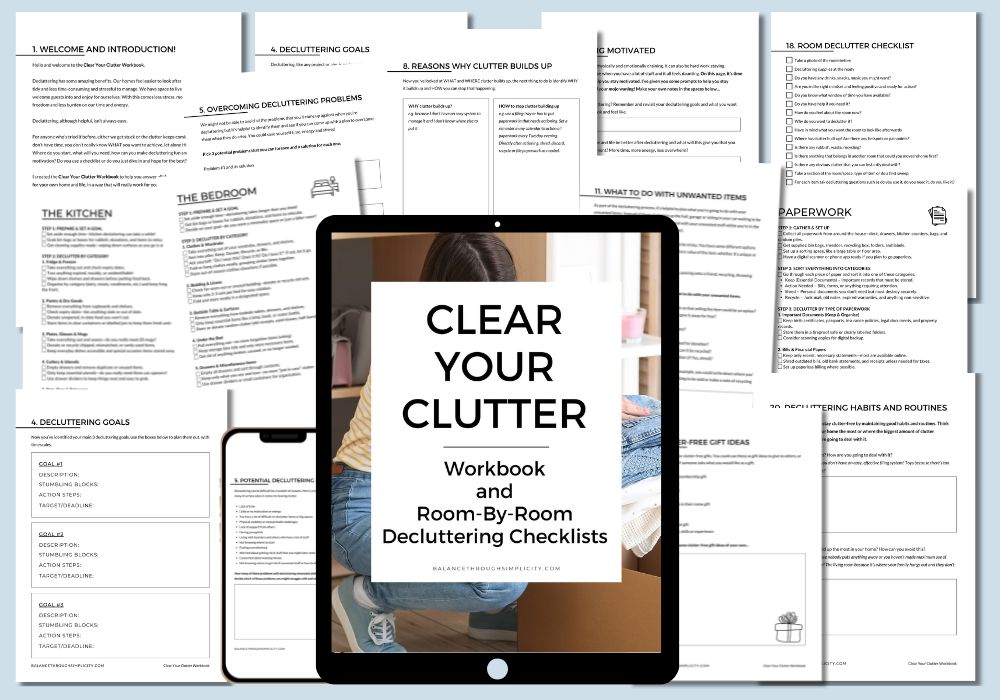
If you’re ready to take your decluttering a little further, my Clear Your Clutter workbook will guide you through the process step by step. It includes practical prompts and exercises to help you decide what to keep, what to let go of and how to create more space and calm throughout your home.
Click here to learn more about Clear Your Clutter.