How to Create Social Media Boundaries That Actually Improve Your Life
Creating simple, supportive social media boundaries can help you reclaim your time, protect your energy, and feel more present in your everyday life. Instead of quitting altogether, it’s about using social media more intentionally in a way that genuinely supports your wellbeing. In this article, we’ll explore gentle, practical ways to set boundaries that actually stick.
HOW TO IMPROVE YOUR LIFE BY CREATING BOUNDARIES FOR YOUR SOCIAL MEDIA USE
Social media is woven into modern life in a way that’s hard to ignore. It keeps us connected, informed, entertained—and sometimes overwhelmed, distracted, and quietly drained.
Most of us don’t set out to spend more time scrolling than we intended. It just… happens. A quick check turns into twenty minutes. A moment of curiosity becomes comparison. And before we know it, we feel a little less intentional and present in our own lives.
I’ve found that the goal isn’t to quit social media entirely (unless that genuinely feels right for you), but to use it more intentionally. To create boundaries that protect your time, your energy, and your sense of self—without adding pressure or guilt.
Because when social media stops spilling into every corner of your day, something really good happens: you get your life back.
8 Ways to Create Social Media Boundaries That Actually Improve Your Life
In this article we explore how to gently create those boundaries in a way that feels supportive, realistic, and sustainable.
1. Notice How Social Media Actually Makes You Feel
Before changing anything, it helps to understand what’s really going on beneath the surface of your scrolling habits. Social media can feel so automatic that we rarely stop to question it—we pick up our phone, open an app, and scroll without much conscious thought.
But the impact it has on you can vary hugely depending on what you’re seeing, how you’re feeling beforehand, and how long you stay there. Some content might genuinely uplift or inspire you, while other content can quietly chip away at your confidence, focus, or mood without you fully realising it in the moment.
For myself, I can sometimes detect a difference in my mood and state of mind from before I started scrolling to after. Happy to sad, yearning for positive inspiration to dealing with depressing information overload, to name but a couple.
Building awareness here gives you a foundation to make changes that actually suit you. Instead of assuming social media is “good” or “bad,” you begin to notice your own patterns—and that’s where real, lasting change begins.
Try this:
- At the end of a scroll, pause and ask: Do I feel better or worse?
- Notice which accounts leave you feeling calm, inspired, or uplifted
- Gently unfollow or mute anything that consistently drains you
2. Decide What Role You Want Social Media to Play
If you don’t consciously decide how social media fits into your life, it will quietly expand to fill any available space. It becomes the default in-between activity—something you reach for when you have a spare minute, when you feel bored, or when you want to avoid something else.
Over time, this can make it feel like social media is in control, rather than you. And that’s often where frustration or guilt starts to creep in.
Taking a moment to define its role brings you back into the driver’s seat. It doesn’t need to be rigid or overly structured—just a gentle sense of purpose. When you know why you’re using it, it becomes easier to recognise when you’re drifting away from that intention.
This is especially helpful if you use social media for work or creative projects, where the lines can easily blur between purposeful use and passive scrolling.
One thing I’ve started to do is ‘tether’ my phone to a particular room. I leave it on the kitchen counter, where I can hear it ring if someone needs me but so that I’m not carrying it around with me from room to room and all too easy to reach for. It stays rooted or ‘tethered’ to my kitchen.
Try this:
- Write one sentence: “I want to use social media to…” (e.g. learn, connect, promote your work)
- Keep that intention in mind before opening an app
- If you’re self-employed or building something, define clear “work use” vs “personal use”
3. Create Gentle Time Boundaries (Not Rigid Rules)
One of the reasons social media boundaries can feel hard to maintain is because we often approach them with an all-or-nothing mindset. Strict limits or rules can feel restrictive, and when we inevitably don’t stick to them perfectly, it’s easy to give up altogether.
A gentler approach tends to work much better. Instead of trying to eliminate social media or tightly control it, think about creating soft edges around when and how you use it.
Time boundaries help you reclaim parts of your day that might otherwise be lost to mindless scrolling—particularly those quieter moments in the morning or evening that can have a big impact on how you feel.
By giving social media a place, rather than letting it spill into every moment, you create more breathing room in your day without needing constant willpower.
You might find this article helpful about things I do in the morning before checking my phone for some ideas!
Try this:
- Choose 1–2 specific times of day to check social media (e.g. mid-morning and early evening)
- Avoid starting your day with it—give yourself space to wake up first
- Set a quiet cut-off point in the evening to protect your wind-down time
4. Make Your Environment Work For You
We often assume that managing our social media use is purely about discipline or self-control. But in reality, your environment plays a much bigger role than you might expect.
If something is easy to access, visible, and constantly prompting your attention, you’re far more likely to engage with it—often without even thinking. Social media apps are designed this way intentionally, which means you’re not starting on a level playing field.
The good news is that small, simple changes to your digital environment can reduce that constant pull. You’re not removing social media entirely—you’re just creating a little more space between the impulse and the action.
That pause is often enough to help you make a more conscious choice.
Try this:
- Move social media apps off your home screen or into a folder
- Log out after each use so it’s slightly less convenient to re-enter
- Turn off non-essential notifications (this alone can feel like a breath of fresh air)
5. Replace the Habit, Don’t Just Remove It
Social media often fills a role, even if we’re not fully aware of it. It might be a way to unwind, to escape for a few minutes, to feel connected, or simply to fill a small gap in your day.
If you remove that habit without considering what it was providing, you may find yourself drifting back to it—not because you lack discipline, but because the underlying need is still there.
Replacing the habit gives you a more supportive way forward. It allows you to meet that same need in a way that feels calmer, more intentional, or more nourishing.
This doesn’t have to be anything complicated or overly productive. In fact, the simplest alternatives are often the most effective because they’re easy to reach for in the moment.
To give you an example of how I do this, I’ve actually started meditating instead of scrolling. Every time I’m tempted to check my social media feeds, I tell myself no and to put the phone down. Instead, I close my eyes, calm my breathing down, exhale for longer than I inhale, and listen to the sounds of the world around me. This quiet few minutes is about as easy as it comes, with no preparation required and I can do it pretty much anywhere, but it’s amazing how much better I feel for sitting in silence than scrolling my socials.
Try this:
- Keep a short list of “gentle alternatives” (reading a few pages, making a cup of tea, stepping outside)
- Pair your usual scrolling times with something more nourishing
- Ask: What do I actually need right now? (rest, distraction, connection, a break)
6. Protect Your Mental and Emotional Space
It’s easy to focus on how much time you spend on social media, but what you consume matters just as much—if not more.
Your feed is not neutral. It’s a constant stream of other people’s lives, opinions, achievements, and perspectives. Even when you know it’s curated, it can still influence how you see yourself and your own life.
Over time, this can lead to subtle comparison, unrealistic expectations, or a sense that you’re not doing enough or being enough.
Protecting your mental and emotional space means being intentional about what you allow into your world. It’s not about avoiding everything challenging or uncomfortable, but about creating a feed that supports you rather than undermines you.
And, of course, remember that your feed is responsive to what you watch so curate your feed carefully and stay away from anything that you find difficult, triggering and jeopardises your mental health.
Try this:
- Curate your feed so it reflects your values, not just what the algorithm shows you
- Take regular breaks from accounts that trigger comparison or pressure
- Remind yourself: you are seeing a curated snapshot, not the full picture
7. Build in Regular Digital Resets
Even with boundaries in place, it can be helpful to step away from social media entirely from time to time. Not because you’ve done anything wrong, but because constant input can make it harder to hear your own thoughts and feel grounded in your own life.
A short break creates space. It allows your attention to settle, your nervous system to calm, and your perspective to reset.
You might notice small but meaningful shifts—more focus, a slower pace, a greater sense of presence. These resets don’t need to be dramatic or long to be effective.
In fact, the more gentle and realistic they are, the more likely you are to return to them regularly.
Try this:
- Take one social-media-free day each week (or even half a day to start)
- Try a weekend reset once a month
- Notice what changes—your focus, your mood, your sense of time
- Try a digital detox and experiment with how this makes you feel
8. Let It Be Imperfect
Perhaps the most important boundary of all is the one you create around your expectations.
It’s very easy to turn something like this into another area where you feel you should be doing better. But perfection isn’t the goal—and it’s not necessary for meaningful change.
There will be days when you scroll more than you intended, when your boundaries slip, or when you fall back into old habits. That doesn’t undo the progress you’ve made. It’s simply part of the process of changing something that’s deeply ingrained in daily life.
A gentle, flexible approach allows your boundaries to evolve with you, rather than feeling like something you have to constantly enforce.
Try this:
- If you over-scroll, simply notice it and reset the next time
- Avoid turning boundaries into another thing to feel guilty about
- Focus on what’s improving, however small that feels
CONCLUSION
Social media is designed to draw you in. So if you’ve found it hard to manage, that’s not a personal failing—it’s simply how these platforms work.
Creating boundaries isn’t about discipline or restriction. It’s about making space for what matters more.
More presence.
More calm.
More connection to your own life.
And that’s something worth protecting.
And over to you… How do you currently feel about your relationship with social media?
Is there one small boundary you could introduce this week that would make your days feel a little calmer or more intentional?
I’d love to hear what feels realistic for you right now—because often, it’s the smallest changes that make the biggest difference. Share your thoughts in the comments at the end of this article.
WANT MORE HELP TO PROTECT YOUR TIME AND MENTAL ENERGY?
As we’ve talked about in this article, social media is a great way to waste time, create unease in our mind and a myriad other issues. But, of course, it’s not the only thing that takes up our time and energy. There are SO MANY WAYS that we can build a better life by focusing on what matters with less of what doesn’t.
One way to approach this is to think about how you spend your days, what adds to your To Do list and your busy brain full of things to remember and do, places to be and people to see.
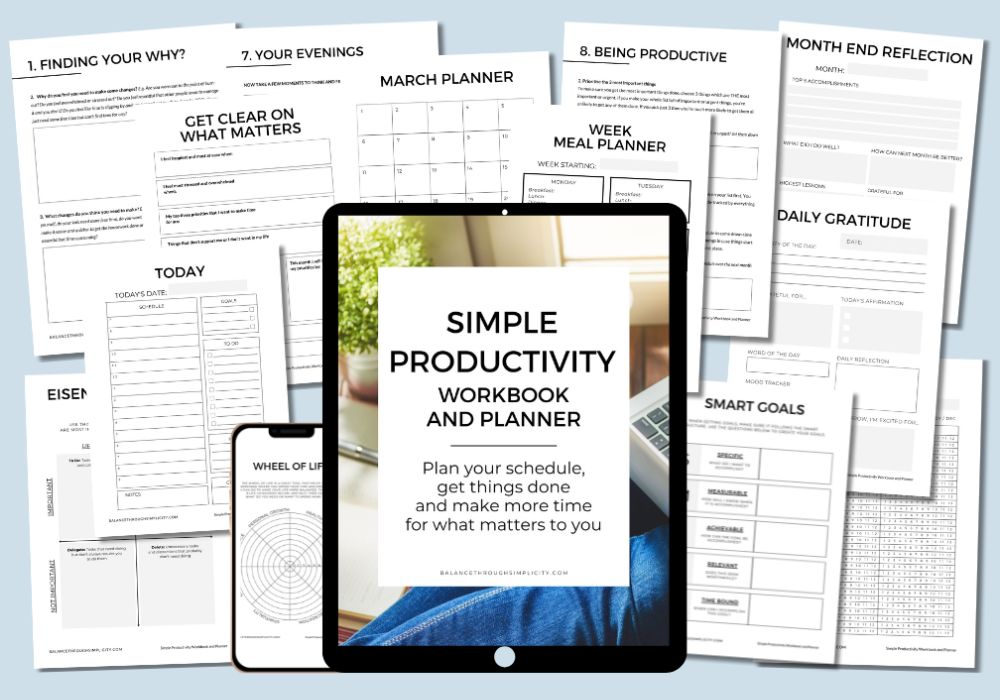
If you’d like to find ways to slow down, be more productive and organised, not just busy, then my Simple Productivity Workbook and printable planning pages can help you do just that.
Click here to learn more and get your copy.
Here are some articles which I hope you find helpful:
- 10 Productive Things to Do on Your Phone
- 7 Gentle Ways to Embrace the Joy of Missing Out
- Comparison Is the Thief of Joy: How to Step Off the Comparison Track
- 20 Ways to Get Rid of Digital Clutter
GET YOUR FREE BOUNDARIES WORKSHEET
Want to set some boundaries in your own life, for your time, your social media usage, or something else? This free worksheet will guide you through the process. Pop your details in the box below and I’ll send it direct to your inbox…
Yes! That’s fantastic Nancy!
So interesting Antonia and great timing. A few days ago I turned off some non-essential notifications and I can already feel less distracted by my phone.
I also set a time blocker for 2 social media apps an hour before my bedtime on weekdays and it has been really helping me to unwind without screens.
Thank you for this article full of advice.
Nancy