

Why Writing Things Down Makes Life Easier
Writing things down can help you clear your mind, organise your thoughts and make everyday life feel a little more manageable. From simple to-do lists and brain dumps to goals and weekly plans, discover how putting things on paper can help you simplify your life and feel less overwhelmed.
WRITING THINGS DOWN HAS MANY BENEFITS FOR AN EASIER LIFE
Writing things down can help you declutter your mind, organise your thoughts, remember what matters and turn vague ideas into practical next steps. You don’t need a complicated journal or elaborate planning system either – sometimes a piece of paper and a pen are enough to make life feel a little more manageable.
I’ve always been a fan of writing things down. Not because I think you need to document every part of your life or spend hours journalling every morning. Quite the opposite. I think writing things down can be one of the simplest ways to make life feel less cluttered.
When you’ve got a lot going on, it’s very easy to keep a running list of things in your head. Things you need to do, things you need to remember, things you don’t want to forget, ideas you might come back to, plans you need to make and problems you need to solve. And the more you try to keep track of mentally, the more overwhelming it can feel.
Writing those things down gives them somewhere to go. Instead of trying to remember everything, you can put it on paper and come back to it when you need it.
Why does writing things down help?
There’s a practical reason that writing things down can be so useful: you don’t have to rely entirely on your memory to keep track of everything.
Psychologists sometimes refer to this as cognitive offloading – using something outside your brain, such as a list, calendar or written note, to reduce the mental effort involved in remembering information. Research into memory offloading suggests that external reminders can improve performance when the information is available when you need it.
And that makes perfect sense in everyday life. If you’ve written down the things you need to do this week, you don’t have to keep reminding yourself of them every time you walk into the kitchen. If you’ve written down an idea, you don’t have to keep thinking, “Don’t forget that!” If you’ve written down the steps for a project, you can concentrate on the next step rather than trying to remember the whole thing.
Writing things down isn’t about having a more complicated system. It’s about giving your brain a little less to carry.
1. Writing things down gets things out of your head
Have you ever been trying to fall asleep while mentally running through everything you need to remember tomorrow? Or been halfway through making dinner when you suddenly remember something you need to do? Or spent the whole afternoon thinking, “There’s something I’ve forgotten…” without being able to remember what it is?
I’ve been there.
Sometimes the problem isn’t that you have too much to do. It’s that you’re trying to keep track of too much information in your head at once. Writing it down gives you somewhere else to store it.
You might write:
- Call the dentist.
- Order a birthday card.
- Book the car in for a service.
- Check the school dates.
- Buy ingredients for Friday.
- Finish that email.
- Look into the holiday.
Suddenly, those thoughts aren’t all competing for your attention. They’re on the page, where you can see them, decide what matters and get on with your day.
2. It can help you organise your thoughts
Sometimes we don’t have a clear problem. We just know that something feels muddled.
Perhaps you’ve got too many ideas and don’t know where to start. Maybe you’re trying to make a decision. Perhaps you’ve got a room that needs sorting, a project you want to tackle or a change you’d like to make, but the whole thing feels too big.
Writing can help you turn that vague feeling into something more concrete.
You could simply start with:
What is bothering me?
Then write whatever comes to mind. Don’t worry about making it neat or writing complete sentences. Just get the thoughts onto the page.
Once they’re there, you can start to see what you’re actually dealing with. Perhaps there are three separate problems hiding inside one big worry. Perhaps one thing needs doing today while everything else can wait. Perhaps you realise that something you’ve been worrying about isn’t actually as complicated as it first seemed.
You don’t always need to find the answer immediately. Sometimes you just need to see the problem clearly first.
3. Writing things down can help you remember
We often assume we’ll remember something later. Sometimes we do. Sometimes we really don’t.
Writing something down gives you a reminder to return to, rather than asking your memory to keep hold of it indefinitely.
Handwritten notes can also involve more active processing than simply typing information word-for-word, which may help with remembering and understanding what you’ve written.
This doesn’t mean you need to carry a notebook around and write down everything that happens. It simply means that when something is genuinely important, write it down rather than relying on yourself to remember it later.
A shopping list, an appointment, an idea, a phone number, something you need to ask someone, a job you don’t want to forget or a thought you want to come back to – these are all perfectly good reasons to reach for a pen.
It’s a small habit, but it can remove a surprising amount of mental juggling.
4. It turns ideas into something you can actually work with
An idea in your head can feel exciting. It can also feel enormous.
- I want to declutter the house.
- I need to sort out our finances.
- I’d love to start exercising.
- I want to get more organised.
- I need to plan Christmas.
These are all perfectly reasonable things to want to do. But they’re not really tasks. They’re ideas.
And an idea becomes much easier to act on when you write down what it actually involves.
Instead of:
Declutter the house
you might write:
- Choose one drawer.
- Empty it.
- Remove anything I don’t use.
- Put the things I’m keeping back neatly.
- Decide what to do with the things I’m letting go.
Now you have somewhere to start.
Research into goal-setting supports the value of making goals more concrete and breaking them into manageable steps. Writing goals down can also help make them feel more tangible and provide something to return to as you work towards them.
You don’t have to plan the whole journey.
Just work out the next step.
5. It can make big jobs feel smaller
One of the easiest ways to feel overwhelmed is to look at an enormous task as one enormous task.
Cleaning the whole house, sorting all the paperwork, planning a holiday, getting your finances organised, decluttering the spare room or preparing for Christmas can all feel like a lot when you’re looking at the whole thing at once.
Instead, write down everything that needs doing and then break it into smaller pieces.
For example:
Instead of “sort out the house”:
- Clear the kitchen worktop.
- Sort the paperwork.
- Empty the hallway cupboard.
- Take donations to the charity shop.
- Tidy the bathroom cabinet.
You haven’t magically created more time. But you’ve changed something important.
You can now see what “getting organised” actually means.
And once you can see the individual jobs, you can choose one. That’s much easier than carrying the whole thing around in your head.
6. Writing things down can help you decide what matters
Lists can sometimes become overwhelming too. If you’ve written down fifty things you need to do, you haven’t necessarily simplified your life. You’ve just created a list of fifty things.
So writing things down works best when you follow it with a little bit of thinking.
Once you’ve got everything on paper, ask:
What actually matters today?
Perhaps there are only two things that genuinely need your attention. Maybe five things can wait until tomorrow. Perhaps three things don’t need doing at all.
This is where writing things down becomes more than simple list-making. It gives you the information you need to make a decision.
You can look at everything that’s competing for your attention and decide what deserves it.
Getting everything out of your head doesn’t mean you have to do everything on the page.
That’s an important distinction.
7. It gives you somewhere to return to
One of my favourite things about writing things down is that you don’t have to solve everything immediately.
Sometimes you just need somewhere to park an idea. Perhaps you have something you want to research, a job you need to do next week, an idea for a project, something you’d like to discuss with someone or a list of things to think about when you’ve got more time.
Write it down.
Then get on with what you’re doing now.
When you’re ready, come back to it.
This is particularly useful if you’re trying to simplify your life because simplifying doesn’t mean remembering more. It often means creating fewer things that you need to keep track of mentally.
8. Writing down your goals can make them more concrete
There’s a difference between thinking:
I’d like to get more organised.
and writing:
This month, I’m going to organise the kitchen cupboards, create a weekly planning routine and clear the paperwork pile.
The second version gives you something to work with. You can see what you’re trying to achieve, break it into smaller actions and come back to it to see how you’re progressing.
Research has found links between written goal-setting, reflection and improved performance, including evidence that writing can help people work through barriers and think about strategies for moving forward.
You don’t have to use a complicated goal-setting method. A piece of paper with three questions can be enough:
- What do I want to achieve?
- Why does it matter to me?
- What’s one thing I can do next?
That’s a pretty good place to start.
You don’t have to journal every day
When people talk about writing things down, it’s easy to assume they mean journalling. And if you enjoy journalling, that’s lovely. But it’s not what I’m talking about here.
You don’t need to write pages about your feelings every morning. You don’t need a beautifully decorated journal. You don’t need to write three pages before breakfast.
You simply need to write down the things that would be useful to have outside your head.
That might be a five-minute brain dump, a weekly planning page, a simple checklist, a few notes about something you’re trying to work out, a list of jobs you want to tackle around the house or a page of ideas that you don’t want to lose.
Keep it practical. Keep it simple. And use whatever format works for you.
Try a simple brain dump
If your head feels particularly busy, try this.
Take a piece of paper and write down everything that’s currently taking up space in your mind.
Don’t organise it as you go. Just write.
Things you need to do, things you need to remember, things you’re worrying about, ideas you’ve had, jobs around the house, things you need to buy, questions you need to answer – anything that’s taking up mental space.
Once you’ve finished, look at the page.
Now sort the list into three simple categories:
Do
Things you actually need to act on.
Decide
Things that need a decision before you can move forward.
Park
Things that matter, but don’t need your attention right now.
This simple brain dump exercise can help you move from “I’ve got so much to think about” to “I can see what’s actually going on.”
And that shift can be incredibly helpful.
Keep your notes somewhere you’ll find them again
There’s one small problem with writing everything down. If you write things on random scraps of paper and then lose them, you’ve simply moved the problem somewhere else.
That’s why I like having a consistent place for useful notes, lists and planning pages. It could be a notebook, a digital notes app, a folder on your computer or a physical binder.
The important thing is that you know where to look.
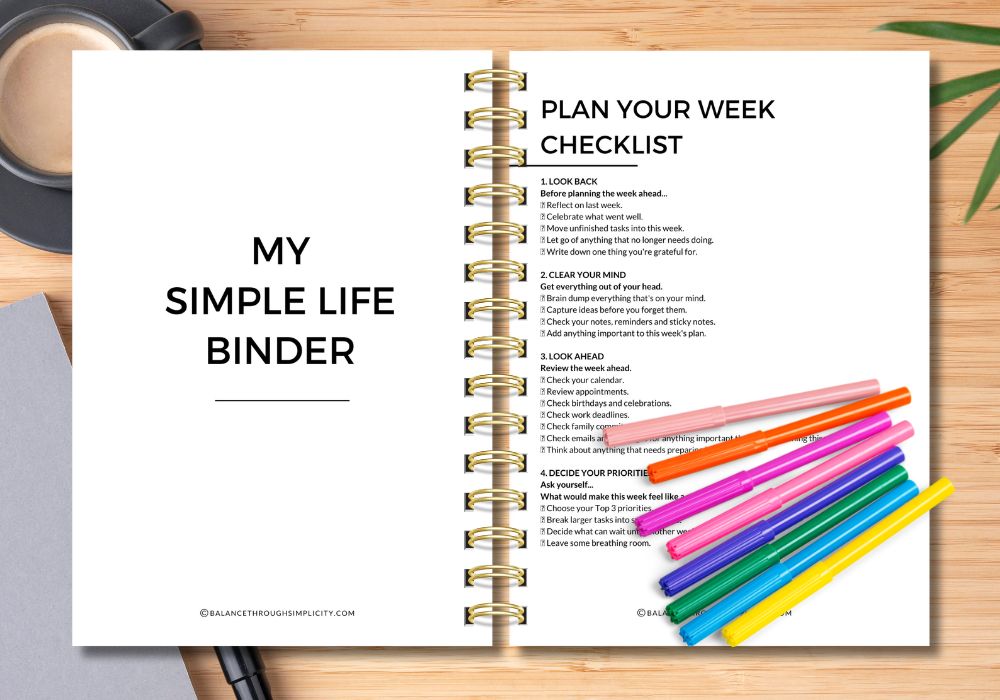
This is one of the reasons I created the Simple Life Binder.
It’s a flexible place to keep the planning pages, checklists, worksheets, notes and other resources you actually use. Rather than having useful pages scattered around the house, you can bring them together somewhere you’ll know to look.
If you’d like to try this approach, you can read how to create your own Simple Life Binder and start building one gradually.
What could you keep in a Simple Life Binder?
You don’t need to fill a binder with every printable you can find. In fact, I’d recommend the opposite.
Choose the pages that genuinely help you.
You might keep:
- weekly planning pages
- monthly planning pages
- household checklists
- meal planning pages
- routines
- goal-setting worksheets
- decluttering plans
- habit trackers
- self-care ideas
- notes and ideas
- lists you use regularly
- useful printables you’ve found on the blog
The idea is to create one simple place for the things you use, rather than another collection of things you feel you ought to use.
And remember that your binder can change. You can remove pages that no longer serve you, add something new when you need it and move sections around.
Keep it as simple as possible.
This is how I use my own simple life binder to organise my life.
Start small
If you’re someone who loves a good list, it’s tempting to turn this into a big project. You could spend an entire weekend finding printables, buying dividers, choosing sections and setting everything up.
But you don’t need to. In fact, I’d suggest you don’t.
Start with one piece of paper.
Write down what’s currently taking up space in your head. Choose one thing that needs your attention. Decide what the next step is.
Then stop.
That’s enough.
Once you discover that writing things down helps you, you can gradually build a system around it. You might create a weekly planning page, then a regular checklist, then a place for your goals and perhaps a section for household organisation.
Let your system grow because you need it, not because you think it should be bigger.
A simple writing habit you can try this week
If you want to make writing things down part of your everyday routine, try this simple approach.
Once a week
Set aside ten minutes and write down:
1. What’s on my mind?
Get everything out.
2. What needs doing?
Turn the vague thoughts into practical tasks.
3. What matters most this week?
Choose your priorities.
4. What can wait?
Give yourself permission not to do everything immediately.
5. What’s one thing I can do next?
Choose the smallest useful step.
That’s it.
You don’t need an elaborate planning routine. You just need a few minutes to pause, think and put things somewhere you can see them.
Grab your free weekly planning workbook at the bottom of this article!
Writing things down is a simple form of decluttering
When we talk about decluttering, we usually mean physical possessions.
But there are other types of clutter too.
There are unfinished thoughts, unmade decisions, things we’re trying to remember, ideas we don’t want to lose, jobs we’re worried we’ll forget and plans we haven’t quite worked out yet.
Writing things down doesn’t make those things disappear. But it can help you separate them, see them and decide what to do with them.
And sometimes that’s enough to make life feel a little lighter.
You don’t have to keep everything in your head. You don’t have to solve everything today. You don’t have to remember every little thing.
Write it down. Give it a place. Come back to it when you’re ready.
A simpler way to keep everything together
If writing things down is something you’d like to do more often, it can help to have one reliable place for your notes, plans and useful pages.
That’s where a Simple Life Binder can be helpful.
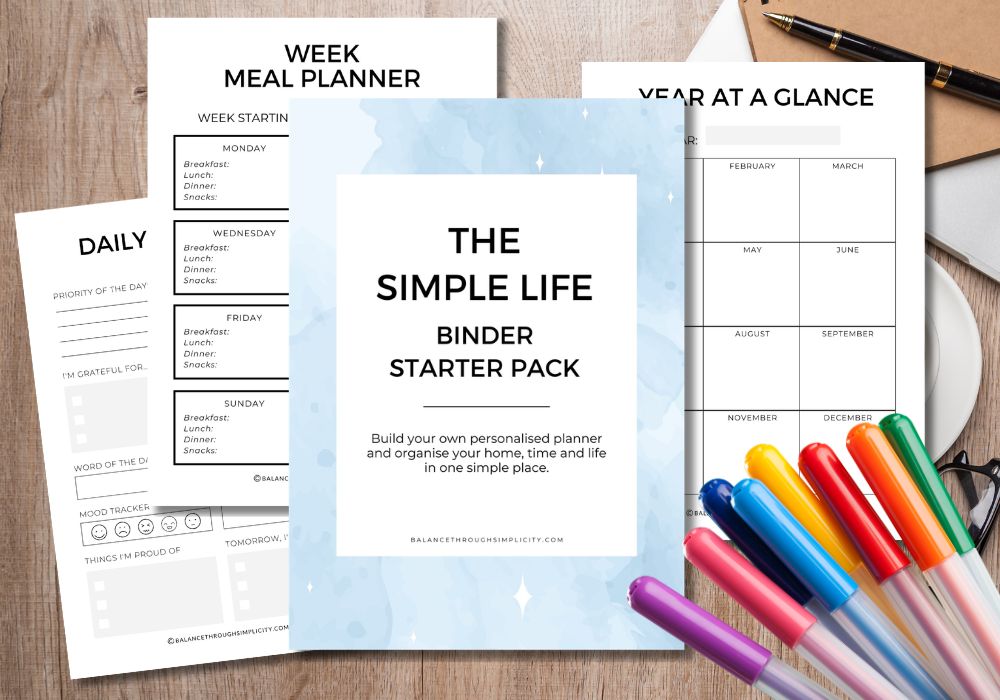
You can build your own gradually, using only the pages that genuinely support your life. And if you don’t know where to start, I’ve created the Simple Life Starter Pack to give you a ready-made foundation.
It includes printable planning pages such as calendars, planners, routines, meal planning, goal-setting pages and habit trackers.
You don’t need to use every page. Choose the ones that are useful to you, put them together in a binder and build from there.
Think of it as somewhere to put the things that would otherwise be taking up space in your head.
You don’t have to remember everything
There’s something quite freeing about realising that you don’t have to remember everything yourself.
You can write it down. You can make a list. You can put an appointment in your calendar. You can create a checklist. You can keep your useful planning pages somewhere you know you’ll find them.
These aren’t signs that you’re disorganised. They’re simply tools that allow you to use your attention for the things that matter, rather than constantly trying to remember what comes next.
Writing things down won’t make life perfectly organised. And it certainly won’t remove every source of stress or overwhelm.
But it can make some things easier.
It can help you see what’s on your mind, decide what matters, turn a big idea into a small next step and give all those loose thoughts, plans and reminders somewhere to live.
Sometimes simplifying your life starts with something as small as picking up a pen and getting it out of your head.
You don’t need to organise everything today.
Just write down what’s on your mind.
Then decide what needs to happen next.
WANT A FREE RESOURCE TO HELP YOU ORGANISE YOUR WEEK?
Why not start today with a checklist to help you plan, simplify and organise your week ahead. It’s a simple place to get started if you’ve been relying on your busy brain to remember your tasks and To Do list!
Pop your details in the box below and I’ll send the checklist straight to your inbox…
Here are some articles you might find helpful to read next: