
7 Signs Your Home Is Making Everyday Life Harder Than It Needs to Be
Your home is supposed to make everyday life easier, not create more work for you. But sometimes, without even realising it, the way our homes are arranged, organised or filled with stuff can make ordinary tasks feel harder than they need to. Here are 7 signs your home might be working against you — and simple, practical things you can do to make it work better for the way you actually live.
IS YOUR HOME WORKING AGAINST YOU?
Have you ever had one of those days when you feel like you’ve been tidying all day, yet somehow the house still looks messy?
Or perhaps you’re constantly looking for your keys, moving things from one surface to another, struggling to put things away because there isn’t really anywhere for them to go, or walking into a room and immediately noticing another five things that need doing.
Sometimes we assume the problem is that we need to be more organised. Perhaps we need a better routine, maybe we need more storage, or perhaps we simply need to try harder to keep on top of everything.
But what if the problem isn’t you?
What if your home simply isn’t working as well as it could for the way you actually live?
I’ve been thinking about this a lot over the years because I’ve gradually realised that a home doesn’t need to be perfectly tidy or beautifully organised to work well. In fact, some of the changes that have made the biggest difference in our home have been very ordinary things — moving something closer to where we use it, getting rid of something we were constantly having to move around, or changing the way a space was being used.
Our homes change as our lives change. What worked five or ten years ago might not work particularly well now.
So, rather than asking yourself, “Why can’t I keep my home organised?”, try asking:
“Is my home actually set up to make everyday life easier?”
Here are seven signs that it might not be.
1. You’re Constantly Tidying the Same Things
This is probably one of the biggest clues.
You tidy the kitchen worktop, only for it to be covered again an hour later. You clear the dining table, and by the following evening it’s covered in post, school paperwork, bags, chargers and random things that don’t really belong there. You put the shoes away, then someone comes home and kicks them off by the door again.
And so you tidy it all over again.
There’s nothing wrong with tidying. Homes get messy because people live in them. That’s normal. But if you are repeatedly tidying the same things in the same places, it’s worth stopping and asking whether the problem is actually the system.
I’ve found this particularly useful in our own home. If something repeatedly ends up in the same place, I try to pay attention rather than simply moving it again. Perhaps that’s where it naturally wants to live.
For example, if everyone takes their shoes off by the back door, it makes more sense to have somewhere for shoes there than to expect everyone to carry them to another part of the house every time.
Try this:
Choose one area that seems to become messy almost immediately after you’ve tidied it. For the next few days, notice what keeps getting left there.
Then ask yourself:
- Does this item have a proper home?
- Is its current storage place convenient?
- Do we actually use this space for something different now?
- Would it be easier if this item lived closer to where we use it?
- Is there something we could remove altogether?
You might discover that you don’t have a tidying problem.
You have a “this doesn’t have an easy place to go” problem.
And that is much easier to solve.
2. Everyday Tasks Take More Effort Than They Should
Another sign that your home might be working against you is when simple tasks seem to involve an unnecessary number of steps.
Perhaps making a cup of tea means moving things off the worktop first. Getting dressed means digging through an overstuffed wardrobe. Doing the laundry means carrying baskets up and down stairs because there isn’t a convenient place for them. Putting something away means opening a cupboard, moving three other things and somehow trying to squeeze it into a space that’s already too full.
None of these things are particularly difficult, but they all involve friction. And when you repeat those little frustrations every day, they can make running your home feel much harder than it needs to be.
I notice this in small ways around our own home. Sometimes I’ll realise I’ve been doing something in an unnecessarily complicated way simply because “that’s how I’ve always done it.”
Once you spot it, you can often make a very simple change. Maybe something needs to move, perhaps a cupboard needs decluttering, maybe an item needs to be stored differently, or perhaps you don’t actually need the item at all.
Try this:
Think about three tasks you do almost every day, such as:
- getting ready in the morning
- making meals
- putting laundry away
- leaving the house
- getting ready for bed
- tidying up after dinner
Choose one and ask:
“What could make this task easier?”
Don’t add another routine. Don’t buy an organiser. Don’t create a complicated system.
Just look for one unnecessary step you could remove.
Sometimes simplifying your home is less about adding something and more about taking something away.

3. You’re Always Looking for Things
There’s a particular kind of frustration that comes from knowing you own something but having absolutely no idea where it is.
You know you saw it recently. You know it must be somewhere. So you start opening drawers, checking cupboards and looking on surfaces. Eventually you find it — usually somewhere that makes you wonder why on earth you put it there.
If this happens regularly, your home may be telling you something.
Perhaps things don’t have clear homes. Perhaps several people are putting things away differently. Perhaps your storage doesn’t match the way you actually use your belongings. Or perhaps you simply have more things than your available space can comfortably accommodate.
A home can look reasonably tidy and still be difficult to navigate. That’s something I think is really important.
An organised home isn’t necessarily a home where everything looks perfect. It’s a home where you can find what you need without having to think too hard about it.
Try this:
Think about the things you regularly lose or search for. Keys, chargers, scissors, important paperwork, cleaning supplies, school things — whatever it happens to be in your house.
Choose one category and give it a genuinely convenient home.
Not the home that looks best. Not the home where Pinterest says it should go. The home that makes sense for you.
And if you find that you don’t have enough space for everything in that category, that’s useful information too.
It might be time to declutter before you reorganise.
4. Your Storage Is Full — But You Still Keep Buying More
When a cupboard becomes difficult to use, our first instinct can be to find more storage. Another basket. Another shelf. A bigger unit. Some clever storage containers.
And sometimes that’s exactly what you need.
But sometimes more storage simply gives us somewhere else to put things without addressing why the space was full in the first place.
I’ve certainly fallen into this trap myself. It’s very tempting to think that if we could just organise everything a little bit better, we’d be able to fit it all in.
But there comes a point when the problem isn’t how you’re storing your belongings.
It’s how many belongings you’re trying to store.
If you have to carefully rearrange a cupboard every time you need something from the back, that’s a clue. If drawers are so full that you have to push them closed, that’s a clue. If you’re constantly moving one thing to get to another, that’s a clue too.
Try this:
Choose one storage space that’s frustrating you.
Before buying anything new, take everything out. Then ask:
“If I were organising this from scratch today, what would I actually choose to keep here?”
Remove anything you no longer use, need or want. Then put the remaining things back in a way that makes them easy to see and reach.
You may find you don’t need another storage solution after all.
You simply needed less to store.
5. Your Home Is Full of Things That Remind You What You Haven’t Done
This one is easy to overlook.
Sometimes clutter isn’t just about how much stuff we own. It’s about what our stuff seems to say to us.
A pile of paperwork can remind you that you haven’t filed it. An exercise bike covered in clothes can remind you that you haven’t exercised. A cupboard full of craft supplies can remind you of the projects you haven’t started. A stack of books can remind you that you haven’t read them. A half-finished DIY project can sit there quietly reminding you that it still needs finishing.
I’ve written before about the silent to-do list created by our belongings, and I think this is one of the most useful ways to look at your home.
Sometimes we walk into a room and immediately see all the things that need doing rather than simply seeing the room itself. That can make home feel much more demanding.
Try this:
Choose one room and look around it slowly.
Instead of asking:
“What looks untidy?”
ask:
“What here is asking something of me?”
Perhaps it’s something that needs fixing, filing, cleaning, returning, finishing, sorting or deciding about.
You don’t have to deal with everything immediately. Simply make a short list and decide:
- What needs doing?
- What can wait?
- What can be delegated?
- What can be discarded?
- What doesn’t actually need doing at all?
Your home doesn’t need to remind you of every unfinished task the moment you walk through the door.
6. Your Home Is Still Set Up for a Life You No Longer Live
This is a big one.
Our homes often change much more slowly than our lives.
You might have children who have grown up. You might now work from home. Perhaps you’ve changed jobs, maybe a hobby has disappeared, or perhaps you’re spending more time at home than you used to. Maybe you no longer entertain in the same way, or perhaps your family simply uses the rooms differently now.
But the house hasn’t caught up.
I’ve experienced this myself over the years as our family has grown and changed. A room that worked brilliantly at one stage of family life might suddenly become much less useful later on.
And I think this is one reason it’s worth periodically looking at your home with fresh eyes. Not because you’ve done anything wrong, but simply because life changes.
Your home should be allowed to change with it.
Try this:
Walk through your home and ask:
“Is this room still being used for the purpose I originally intended?”
Then consider:
- What do we actually use this room for now?
- What do we need easy access to?
- Is there furniture taking up space that we no longer need?
- Is there a better use for this room?
- Are we storing things for a version of our life that no longer exists?
You don’t need to redecorate or completely reorganise your home.
Sometimes simply changing the purpose of a space can make a surprising difference.
7. You Feel Like Your Home Needs You More Than You Want to Give
Perhaps the biggest sign of all is simply this:
Your home feels like work.
There is always something to clean, something to tidy, something to put away, something to organise, something to maintain, something to buy, something to repair or something to sort.
Of course, every home requires some work. That’s just part of having a home.
But your home shouldn’t feel as though it is constantly demanding your attention.
This is something I’ve become much more conscious of over the years. I don’t want a perfectly tidy house if achieving it means spending all my spare time maintaining it.
I’d much rather have a home that’s comfortable, lived-in and reasonably organised, but easy enough to look after.
That’s a very different goal.
I’m not aiming for a showroom.
I’m aiming for a home that works.
Try this:
Ask yourself:
“If I wanted my home to require less effort from me, what would I change?”
Don’t think about what would make it look better. Think about what would make it easier.
Maybe you’d own fewer things. Maybe you’d simplify a cupboard. Maybe you’d stop maintaining a room you rarely use. Maybe you’d move everyday items somewhere more convenient. Maybe you’d create a simpler way of dealing with paperwork. Maybe you’d accept that some things don’t need to be done as often as you think.
Start there.
How to Make Your Home Work Better for You
If you’ve recognised yourself in several of these signs, don’t panic.
You don’t need to completely overhaul your home. You don’t need to spend a weekend decluttering every cupboard, and you certainly don’t need to buy a house full of clever organising products.
Instead, start paying attention.
For the next week, notice the moments when your home makes something harder than it needs to be. Maybe you’re always moving the same pile, constantly searching for the same item, struggling with an awkward cupboard, using a room differently from how you originally intended, or repeatedly putting away something you never actually use.
These little frustrations are useful information. They’re showing you where your home isn’t quite keeping up with your life.
And once you start noticing them, you can make small changes.
A Simple Home Audit
If you’d like to take this a little further, walk through your home with these five questions:
1. What am I constantly tidying?
This could point towards clutter, storage or a missing home for something.
2. What am I always looking for?
This could point towards poor organisation or inconvenient storage.
3. What takes more effort than it should?
This could point towards unnecessary steps or an awkward layout.
4. What reminds me of things I need to do?
This could point towards unfinished projects, paperwork or visual clutter.
5. What no longer fits the way we live?
This could point towards rooms, furniture, belongings or systems that need to change.
You don’t have to solve all five.
Choose one.
That’s enough.
Your Home Doesn’t Have to Be Perfect
I think this is the part that matters most.
A home that works for you isn’t necessarily a perfectly tidy home. It isn’t necessarily minimalist. It doesn’t have to look beautiful all the time, and it certainly doesn’t have to look like anyone else’s home.
Your home is lived in. People come and go. Meals are cooked. Laundry gets dropped on the floor. Packages arrive. Children grow up. Plans change. Life happens.
That’s normal.
For me, creating a simpler home is much more about asking whether the things around us are helping or hindering everyday life.
Does your home make it reasonably easy to find what you need? Can you put things away without having to rearrange everything? Are the rooms being used in ways that make sense for your current life? Are you keeping things because they’re useful and meaningful, rather than because you feel you should?
And perhaps most importantly:
Does your home support the life you’re actually living now?
You don’t need to fix everything. You don’t even need to fix most things.
Start with the one little irritation you notice every single day.
Move something. Remove something. Try an easy way to declutter. Give something a better home. Change the way a space is used. Make one everyday task a little easier.
Because sometimes the biggest improvements aren’t the dramatic ones. They’re the small changes that make you think:
“Oh, that’s so much easier.”
And isn’t that what we really want from our homes?
Not perfection.
Just a home that works for us, rather than one that constantly feels like another thing we have to manage.
Your home should support your life, not add to it.
And if something in your home isn’t working, you have permission to change it.
READY TO CLEAR YOUR CLUTTER?
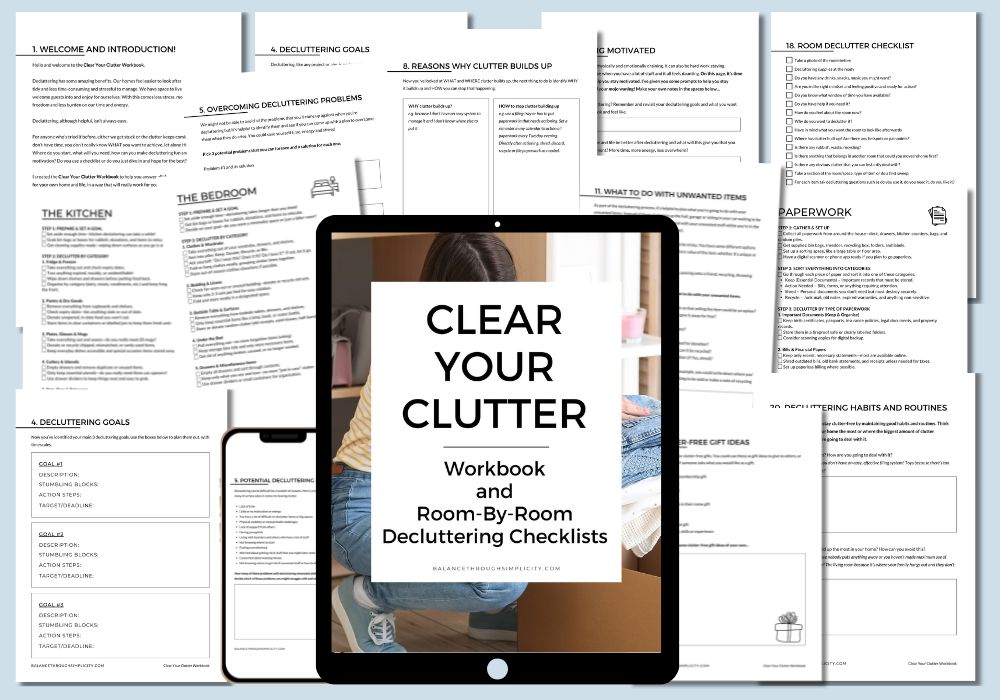
If you’re ready to tackle the clutter but aren’t sure where to start, my Clear Your Clutter Workbook gives you a practical, step-by-step way to work through your home without feeling overwhelmed.
You’ll also find decluttering checklists and simple prompts to help you decide what to keep, let go of and tackle next.
Whether you’re starting with one drawer or working your way through the whole house, these resources are designed to help you make steady progress and create a home that feels calmer, lighter and easier to manage.
Learn more about Clear Your Clutter.
WANT TO START SMALL?
Not ready for a full decluttering project yet? Start small with my free 40 Quick Declutter Projects Checklist, with 40 simple projects you can tackle in 5 minutes or less. It’s an easy way to start making progress without feeling overwhelmed.
READ THESE NEXT…
Want to learn more about how you can create a calm, clutter-free home that really supports you? Here are some more articles that I’ve selected which you might find helpful:
- How to Reset Your Home So It Stays Tidy and Clutter-Free
- 8 Daily Habits to Keep Your Home Clean All the Time
- Home Management Tips for When You’re Feeling Overwhelmed
- 20 Little Things That Make My Home Feel Simpler
- 12 Ways to Enjoy Your Home More and Make It Work For You
- How to Enjoy Your Home More When You Can’t Change It
- What Should Your Home Really Look Like? 5 Questions to Help You Decide
Hi Nancy, I hope these tips might help. Thank you for reading and sharing your thoughts.
Thank you Antonia, I do feel my home requires a lot of constant effort. Number 5 specially, things reminding me of needs to be done. I feel it’s one long to-do list and I hardly keep up. Thanks for the advice.
Nancy