
What Should Your Home Really Look Like? 5 Questions to Help You Create a Home That Works for You
If you’ve ever wondered what your home should really look like, how tidy it should be or why you can’t seem to keep on top of everything, you’re not alone. This guide explores how to let go of unrealistic expectations, create a home that works for your real life and find a gentler approach to decluttering, cleaning and organising.
WHAT SHOULD YOUR HOME REALLY LOOK LIKE?
Have you ever looked around your home and thought, I really should be doing better than this?
Perhaps you think you should have decluttered by now. You should be more organised. You should be able to keep on top of the cleaning. You should have a better system for the laundry, paperwork or household chores.
Perhaps you’ve even looked at someone else’s home and wondered why theirs seems to work so much better than yours.
I’ve had plenty of those thoughts myself.
But the more I think about simplifying our homes and making them work better for the people who live in them, the more I realise that perhaps we’re asking the wrong question.
Instead of asking “What should my home look like?”, perhaps we should be asking:
“What does my home need to do for me and my family right now?”
Because our homes don’t exist separately from our lives. They’re affected by our circumstances, our energy, our responsibilities, our relationships and the particular season of life we’re in.
And sometimes, the home that looks perfectly organised from the outside simply isn’t the right goal for you.
We have so many ideas about what our homes should look like
We’re surrounded by messages about what a “good” home looks like.
A tidy kitchen. Clear surfaces. Organised cupboards. Beautiful storage. A perfectly made bed. A laundry system that somehow means there is never a pile of washing waiting to be dealt with.
Then there are the expectations we put on ourselves.
- I should clean more.
- I should declutter that cupboard.
- I should be more organised.
- I should get the children to help more.
- I should be able to keep on top of everything.
The trouble is that every “should” can become another source of pressure.
And when we don’t manage to do the things we think we should, it’s very easy to turn that frustration inwards. We can start to feel guilty, inadequate, lazy or as though we’re somehow failing at something that everyone else seems to manage.
But your home is not a test that you can pass or fail.
Your home is part of your real life
Life has a habit of changing.
There are times when we have more energy and capacity and can happily tackle a big decluttering project or spend an afternoon cleaning and organising.
There are other times when simply getting through the day takes everything we have.
Work can become stressful. Money can be tight. Relationships can be complicated. We might be caring for someone, raising children, dealing with a change in circumstances or simply trying to keep going through a difficult period.
Our capacity changes too.
I’ve experienced this in my own life, and it’s something I’ve become increasingly aware of through the work, courses and learning I’ve done around homes, people and how our environments can support us.
I also live in a neurodivergent home, so I understand something of the tension between knowing that something needs doing and not being able to make yourself do it in the way you think you should.
You can know exactly what needs to happen. You can genuinely want to do it. You can even have a plan sitting in front of you.
And yet somehow, getting from I need to do this to I’ve actually done it can feel much harder than it looks from the outside.
That can be incredibly frustrating.
It’s also one of the reasons I think we need to be careful about assuming that one household strategy will work for everyone.
A routine that makes one person’s life easier might make another person’s life feel more complicated. A beautifully organised system might be helpful in one household and completely impractical in another.
The strategy has to fit the person and the life.

Your home doesn’t have to look a certain way to be a good home
I write a lot about decluttering, simplifying and organising because these things really can make everyday life easier.
But I don’t think the purpose of decluttering is to create a home that looks a particular way.
The purpose is to create a home that supports the life you’re actually living.
- That might mean having fewer possessions because clutter makes you feel overwhelmed.
- It might mean having a very simple cleaning routine because you don’t want to spend your evenings cleaning.
- It might mean keeping things visible because putting them away means you forget they exist.
- It might mean accepting that your home will look lived-in because you have children, pets, hobbies, work, visitors or simply a busy life.
- It might even mean deciding that some things aren’t important enough to spend your limited time and energy on.
There is no prize for having the tidiest house.
And there is certainly no moral value attached to the state of your kitchen, bedroom or laundry basket.
A messy home doesn’t make you a bad person. A tidy home doesn’t make you a better one.
If you’re interested in the connection between your surroundings and how your home feels, you might also like my article on how to make your home feel simpler, where I explore some practical ways to create a home that feels easier and calmer without trying to achieve perfection.
Five gentle questions to ask yourself
If you’ve been feeling pressure about your home recently, rather than immediately making a new cleaning schedule or deciding you need to declutter everything, try stepping back and asking yourself these questions.
1. What am I telling myself I should be doing?
Listen for the “shoulds”.
What are you expecting yourself to clean, organise, declutter or maintain?
Some of those things may genuinely matter to you. Others may simply be expectations you’ve absorbed from other people, social media or the homes you’ve seen around you.
You don’t have to automatically turn every “should” into a task.
2. What is actually making life harder at home?
Instead of focusing on what looks untidy, think about what is creating friction.
- Are you constantly looking for things?
- Is there too much stuff to put away?
- Does laundry pile up because the system is too complicated?
- Does a particular room make you feel stressed as soon as you walk into it?
- Does cleaning take much longer than you’d like?
These are useful clues because they point towards problems that are actually worth solving.
For example, if clutter itself is creating stress, you might find it helpful to read my article on clutter and stress next. It looks at the relationship between the physical things around us and the feeling of being overwhelmed.
3. What would make my home easier to live in?
This is one of my favourite questions because it changes the focus from appearance to function.
- Perhaps you need fewer possessions.
- Perhaps you need better storage.
- Perhaps you need to make things easier to reach.
- Perhaps you need to simplify a routine.
- Perhaps you need to stop doing something altogether.
The answer doesn’t have to involve buying anything or creating a complicated new system. Sometimes the simplest solution is to remove something rather than organise it better.
This is also where decluttering can be really useful. If you’re wondering whether you should organise or declutter first, take a look at this article on why declutter instead of organise.
4. What am I expecting myself to manage right now?
Take an honest look at your current season of life.
How much time do you have? How much energy? What else is taking up your attention?
A household that is manageable when life is calm may feel completely unmanageable when you’re exhausted or dealing with additional responsibilities.
Your expectations may need to change with your circumstances.
That’s not giving up. Instead, it’s being realistic about your capacity.
5. What would “good enough” look like for me?
I think this is a particularly important question.
We don’t always need to get things finished. Sometimes we need to decide what is enough.
- Perhaps “good enough” means the kitchen is clean enough to cook dinner.
- Perhaps it means there is a clear path through the room even though the surfaces aren’t tidy.
- Perhaps it means the laundry is washed but not folded.
- Perhaps it means you’ve done one small job instead of the ten you had planned.
- And sometimes, particularly during difficult periods, getting out of bed is enough.
- Sometimes making the bed is enough.
- Sometimes doing one small thing to make tomorrow easier is enough.
Good enough isn’t a failure. Sometimes it’s exactly what you need. And it’s often better for us than chasing perfection.
When getting started is the hardest part
One thing I know from my own experience is that knowing what to do and actually getting started aren’t always the same thing.
Sometimes the problem isn’t a lack of information. You might already know exactly how to declutter the cupboard, clean the kitchen or organise the paperwork.
The difficult part is starting.
- Or deciding what to do first.
- Or finding the motivation.
- Or working out how to keep going once you’ve started.
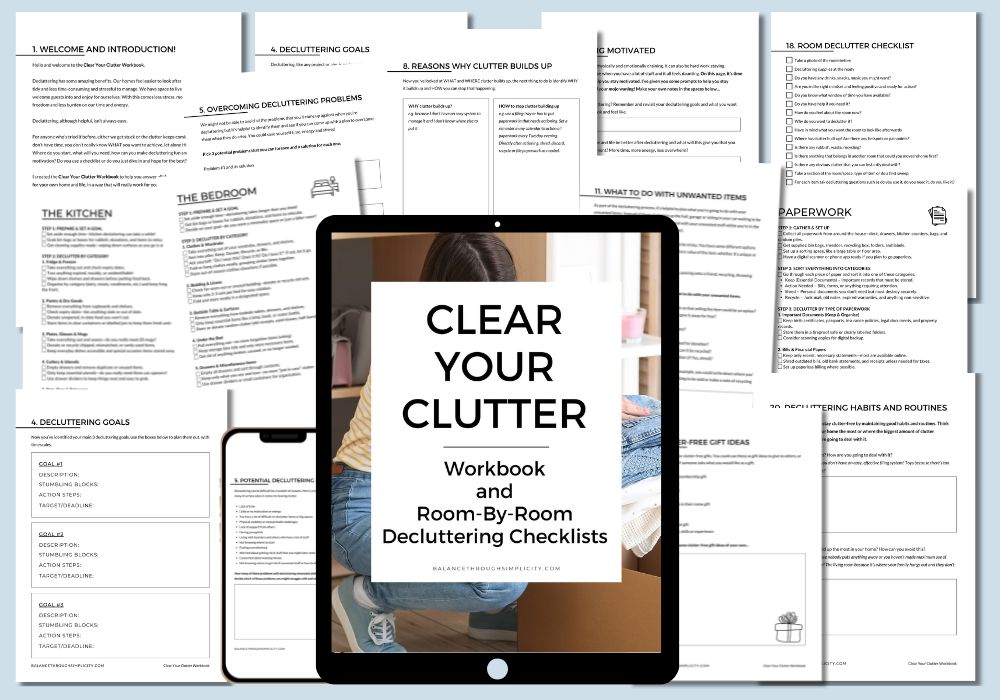
That’s one reason I created my Clear Your Clutter Workbook.
It’s designed to give you somewhere to work through the process rather than simply giving you another list of things you should do.
There are lots of journal prompts and reflection exercises to help you think about your clutter, your habits and what you actually want from your home. There are also practical checklists that you can print and use whenever you need them.
So if you struggle with getting started, task initiation, motivation or following through, you don’t have to sit down and complete the whole workbook in one go.
You can simply print the checklist you need, work through it at your own pace and tick things off as you go.
Sometimes having something concrete in front of you makes the first step feel much more manageable.
Explore the Clear Your Clutter Workbook.
Stop using your home as a measure of how well you’re doing
One of the things I’d really like to change about the way we talk about home and housework is the idea that the state of our home says something about the kind of person we are.
It doesn’t.
Your home is a reflection of your circumstances, your habits, your priorities and the people who live there. It is going to change as your life changes.
- There will be tidy days and messy days.
- There will be weeks when you feel completely on top of things and weeks when you don’t.
- There will be rooms that work brilliantly and rooms that need a rethink.
That’s normal.
Instead of asking whether your home looks as though it should, try asking whether it is helping you live the life you actually have.
- That might mean decluttering.
- It might mean simplifying.
- It might mean changing a routine.
- It might mean accepting a little more mess.
And sometimes, it might mean doing absolutely nothing about the house today because something else needs your time and energy more.
Your home should support you, not become another source of pressure
I believe our homes can have a really important role in helping us feel calmer, more comfortable and more supported.
But creating a supportive home isn’t about achieving a perfect aesthetic or keeping everything spotless.
It’s about paying attention to what you need.
It’s about noticing where your home creates unnecessary work, stress or frustration and looking for simple ways to make things easier.
And it’s about recognising that the right solution for someone else may not be the right solution for you.
- Your home doesn’t need to look like anyone else’s.
- It doesn’t need to meet an imaginary standard.
- It doesn’t need to be perfect.
It just needs to support the life you’re actually living.
So if you look around your home today and see things that you think you should have done, perhaps pause before adding another task to the list.
Ask yourself what you really need. Then start there.

Read These Next…
If this way of thinking about your home resonates with you, you might also enjoy:
- Signs Your Home May Be Working Against You – some useful clues that your home might be creating more work or stress than it needs to.
- How to Enjoy Your Home More When You Can’t Change It – because sometimes the answer isn’t a renovation, a makeover or a huge decluttering project.
- How to Spend Less Time Cleaning: Minimalist Cleaning Routines – practical ideas for spending less of your precious time keeping your home clean.
- Decluttering With ADHD: 9 Tips to Help Clear Clutter — practical tips for making decluttering feel more manageable when getting started, making decisions or dealing with overwhelm can be difficult.
- ADHD Cleaning Tips: Ways to Help Keep a Clean Home — a look at why keeping on top of cleaning can feel challenging, with practical ideas for making household tasks easier and more manageable.
- Minimalism and ADHD — explore how simplifying your home and reducing the demands of your environment may help create a space that feels easier to live in, while recognising that there’s no one-size-fits-all approach.
The aim isn’t to create a perfect home. It’s to create a home that makes your life a little easier.
And over to you… I’d love to hear your thoughts on this. Do you ever find yourself caught between what you think you should be doing at home and what you actually have the time, energy or capacity to do? Has changing your expectations, simplifying your approach or finding a different way of doing things made your home feel easier to manage? Share your thoughts in the comments — I’d really love to hear what works for you.
Hi Lisa, yes exactly. Thank you so much for sharing this excellent example.
At this stage of life, 4 of our grandkids, ages 6 to 12, visit almost every Sunday pm. Although they are good at tidying up, we still have a lot of books that “live” on a side table, board games stacked on the coffee table, small cars in a basket, and stuffies in a soft sided bin. And at this season of life, the enjoyment of their visit far outweighs the “organised clutter” that it leaves in our otherwise quiet home. “To every thing there is a season.”
Hi Nancy, yes I agree. Many of us don’t need any extra pressure! Thank you for reading and sharing your thoughts.
Thank you Antonia for this very realistic article, I liked the phrase “you don’t have to turn every should into a task.” I will keep it in mind. And also it’s a good reminder that our home is there to support us, not to put more pressure on us.
Thank you!