8 Ways to Declutter Your Garden and Make It Easier to Look After
Wondering how to declutter your garden without turning it into another big project? In this article, I’ll show you how to declutter your garden using the same simple principles you use inside your home, so you can create an outdoor space that’s easier to maintain, feels calmer and is somewhere you genuinely enjoy spending time.
Do You Need to Declutter Your Garden?
Whether you have a large garden, a small patio, a courtyard or even just a balcony with a few pots, your outdoor space is an extension of your home. Just like the rooms inside your house, it should support the way you live, make everyday life easier and be somewhere you genuinely enjoy spending time.
When we moved into our home about three years ago, the garden had lots of potential, but it also needed quite a bit of attention.
It wasn’t neglected exactly, but it felt rather high maintenance, a little untidy in places and not particularly suited to the way our family lives.
There were borders that needed attention, plants growing where they probably shouldn’t have been and plenty of little jobs that seemed to keep getting added to the list.
We could see what the garden could become, but we also knew we didn’t want to spend every weekend working in it. Instead, we wanted somewhere that felt peaceful, easy to look after and somewhere the whole family could enjoy.
Somewhere we could relax with friends over a barbecue, kick a football around, enjoy a warm evening or simply sit quietly with a cup of tea first thing in the morning, which is probably my favourite way to start the day.
Over the last few years, we’ve slowly transformed the space. We haven’t done everything at once and we certainly haven’t tried to create a show garden. Instead, we’ve focused on making it work better for us.
As I was pottering around the garden recently, it suddenly struck me that I wasn’t really following gardening advice at all. Without even realising it, I’d been using many of the same decluttering principles that I’ve been sharing here on the blog for years.
We often think of the garden as something separate from our home, but if you spend time there, entertain there, relax there or simply enjoy looking out at it from the kitchen window, then it’s very much part of your home too.
Decluttering has never really been about getting rid of things.
It’s about creating spaces that support the way you want to live.
8 Ways to Declutter Your Garden Using the Same Principles You Use in Your Home
Whether your outdoor space is large or small, whether you love gardening or simply enjoy sitting outside with a good book, I hope these ideas inspire you to create a garden that feels calmer, simpler and easier to enjoy.
1. Decide How You Want Your Garden to Work
Whenever I help people declutter their homes, I always encourage them to think about how they want each room to function before they start sorting through their belongings.
The same principle applies outside.
Before buying more plants, moving flower beds or adding another decorative feature, take a step back and ask yourself one simple question:
How do I actually want to use this space?
Your answer doesn’t have to look like anybody else’s.
Perhaps you love gardening and dream of colourful borders that change with the seasons. Maybe you have children or grandchildren who need somewhere safe to play. Perhaps you’d love a quiet corner where you can sit with a book and your morning coffee. Or maybe your priority is simply having a tidy, low-maintenance garden that doesn’t demand hours of work every weekend.
There’s no right or wrong answer.
The important thing is that your garden reflects your lifestyle, not somebody else’s expectations.
Once you know how you want your garden to support your life, it becomes much easier to decide what deserves your time, energy and money—and what doesn’t. Just as every room in your home has a purpose, your garden will feel more successful when each area has one too.
Try this:
Before picking up a trowel or buying another plant, spend ten quiet minutes sitting in your garden with a notebook.
Ask yourself:
- What do I enjoy most about this space?
- What do I use it for most often?
- What do I wish I used it for more?
- What frustrates me every time I come outside?
Your answers will help you create a garden that suits the life you live now, not the one you think you should have.
2. Let Go of Anything That No Longer Serves a Purpose
One of the very first jobs we tackled was simply removing things that had gradually accumulated over the years.
- Broken pots.
- Rusty ornaments.
- Old pieces of timber.
- Unused containers.
- Random items tucked behind the shed that nobody had looked at for years.
Garden clutter builds up just as quietly as household clutter. The only difference is that because it’s outside, we often stop noticing it. Before long, the things we no longer use simply become part of the scenery. We have clutter blindness.
Every broken pot, unused planter or worn-out garden decoration still takes up physical space. It also creates visual clutter, making the whole garden feel busier and more overwhelming than it really is.
As with decluttering your home, I found it helpful to ask a few simple questions.
- Does this still have a purpose?
- Do I actually use it?
- Would I choose to keep it if I were starting from scratch?
If the answer was no, it was probably time to let it go.
That doesn’t mean your garden has to look sparse or minimalist. It simply means making room for the things that genuinely add beauty, function or enjoyment. Every item you remove creates a little more breathing space, and sometimes that’s exactly what a garden needs.
Try this:
Walk slowly around your garden with a garden waste bag or wheelbarrow.
Challenge yourself to find ten things that are broken, worn out or no longer serving any useful purpose.
You don’t have to tackle everything in one afternoon. Even removing a handful of unnecessary items can make your garden feel lighter, tidier and much more inviting.
3. Keep Only What You Actually Use
Have you ever opened your shed or outdoor storage and wondered how on earth it became so full?
Garden tools, half-used bags of compost, spare plant pots, old watering cans, packets of seeds, lengths of hosepipe and bits of wood all seem to multiply without us really noticing.
It’s very similar to what happens inside our homes. We keep things just in case they might come in useful one day, because we spent money on them or simply because we’ve forgotten they’re there.
I know I’ve done exactly the same.
As I started sorting through our own garden, I realised there were plenty of things we’d been storing for years without ever using them. They weren’t making the garden easier to maintain—they were simply taking up valuable space.
That doesn’t mean you should get rid of everything. If you genuinely use a particular tool every few weeks, then of course keep it. The aim isn’t to own less for the sake of it. It’s to make your garden easier to enjoy and easier to look after.
The more unnecessary items you remove, the easier it becomes to find what you actually need. Suddenly, gardening feels less like a treasure hunt and more like an enjoyable hobby.
Just as I often say when decluttering your home, keep the things that support the life you live today—not the life you might live someday.
Try this:
Choose one area to declutter today. It could be your shed, a storage box, a cupboard in the garage or even just one shelf.
As you pick up each item, ask yourself:
- Have I used this in the last year?
- Would I buy it again today?
- Does it still earn its place in my garden?
If the answer is no, perhaps it’s time to donate it, recycle it or pass it on to someone who’ll make good use of it.
4. Create Simple Zones
One of the biggest improvements we made was giving different parts of the garden a clear purpose.
Inside our homes, each room has a job. The kitchen is for cooking. The bedroom is for sleeping. The dining room is for eating together.
When each space has a purpose, your home naturally feels easier to use.
Gardens work exactly the same way.
As we gradually changed ours, we realised we wanted different areas for different activities. We wanted a lawn where we could kick a football around, a comfortable seating area for relaxing with friends, somewhere practical for the barbecue and borders that added colour without creating endless work.
Once we’d decided how we wanted each area to function, it became much easier to decide what belonged there—and just as importantly, what didn’t.
Creating simple zones doesn’t mean you need a large garden.
Even on a small patio you might have a corner for relaxing, another for herbs or flowers and somewhere practical for storing your watering can and gardening tools.
Giving every area a purpose helps reduce visual clutter and makes your garden feel much more intentional.
Try this:
Draw a simple sketch of your garden.
It doesn’t have to be artistic—just a rough plan.
Label each area according to how you’d like to use it.
For example:
- Relaxing
- Entertaining
- Playing
- Growing vegetables
- Wildlife
- Storage
Once you’ve done that, ask yourself whether your garden currently supports those activities, or whether a few small changes could make it work much better.
5. Choose Easy Over Complicated
This has probably been the biggest lesson we’ve learnt over the last few years.
It’s so easy to admire beautiful gardens on television, Pinterest or Instagram and think ours should look the same.
But many of those gardens require an enormous amount of time, money and effort to maintain.
There’s absolutely nothing wrong with deciding that’s not the lifestyle you want.
We realised quite quickly that we’d rather spend time enjoying our garden than constantly working in it.
So, little by little, we’ve chosen plants that suit our garden, simplified some of the borders and looked for ways to reduce maintenance wherever we can.
That doesn’t mean our garden is boring. It simply means it works for us.
In many ways, it’s exactly like decluttering your home. The simplest solution is often the one you’ll be able to maintain for years to come.
A beautiful garden isn’t necessarily the one with the most plants, the fanciest furniture or the biggest collection of pots.
Sometimes it’s simply the one that gives you the greatest sense of peace.
Try this:
Think about one gardening job you regularly put off because it feels like too much work.
Then ask yourself:
- Is there a simpler way of doing this?
- Could I replace a high-maintenance plant with an easier one?
- Could I reduce one border instead of adding another?
- Am I making life harder than it needs to be?
Remember, your goal isn’t to create more work.
It’s to create a garden that’s a pleasure to spend time in.
6. Make It Easy to Tidy Up
One thing I’ve learnt from decluttering homes is that it’s much easier to stay organised when everything has a place to belong.
The same principle works just as well outside.
After all, it’s difficult to keep a garden tidy if your tools are scattered around the patio, the children’s football is left on the lawn and the outdoor cushions don’t have anywhere to go when it rains.
As we organised our own garden, we tried to think less about how it looked and more about how it functioned. We wanted it to be easy to put things away after we’d finished using them. The less effort it takes to tidy up, the more likely you’ll do it.
Whether it’s a storage bench, a shed, a waterproof storage box or simply a designated shelf in the garage, having a home for your outdoor items makes everyday maintenance much simpler.
It’s exactly the same principle I use throughout my house. When everything has a place, tidying becomes quicker, easier and much less overwhelming.
Try this:
Choose one category of outdoor items today.
It might be:
- Garden tools
- Outdoor cushions
- Children’s toys
- Plant pots
- Barbecue equipment
Ask yourself, “Does everything have a proper home?”
If not, spend just fifteen minutes creating one. Your future self will thank you every time you tidy the garden.
7. Leave Some Breathing Space
One of the biggest lessons decluttering has taught me is that every empty space doesn’t need to be filled.
In fact, it’s often the empty space that makes a room feel calm.
The same is true in the garden.
When we’re gardening, it’s easy to think we need another pot, another ornament or another flower bed to make the space look complete.
But sometimes adding more simply creates visual clutter.
As we’ve simplified our own garden, I’ve realised how much I enjoy having areas that feel open. A little space around a seating area. A lawn that isn’t crowded with ornaments. Borders that have room for plants to grow rather than being packed full from edge to edge.
Leaving some breathing room allows your favourite plants and features to stand out. It also creates a feeling of calm that’s sometimes difficult to explain but very easy to appreciate.
Nature doesn’t need to feel crowded to feel beautiful.
Sometimes less really is more.
Try this:
Before buying another plant, pot or garden ornament, pause for a moment and ask yourself:
- Will this genuinely improve my garden?
- Or am I simply filling an empty space?
- Could leaving this area clear actually make the garden feel calmer?
Remember, empty space isn’t wasted space. It’s often what allows the rest of your garden to shine.
8. Create a Garden That Works for You
Perhaps this is the most important lesson of all.
It’s very easy to compare our gardens with the beautifully styled photographs we see online or the immaculate gardens we walk past on sunny afternoons.
But your garden doesn’t have to look like anyone else’s.
- It doesn’t have to win awards.
- It doesn’t have to be perfect.
- It simply has to work for you.
If you love growing vegetables and spending every weekend gardening, that’s wonderful.
If you’d rather have comfortable seating, easy-care shrubs and somewhere peaceful to enjoy your morning coffee, that’s wonderful too.
There’s no single definition of the perfect garden because every family lives differently.
The best gardens aren’t necessarily the most expensive or the most impressive.
They’re the ones that support the people who use them.
That’s exactly the philosophy I’ve always shared when talking about decluttering your home. Don’t organise your spaces around someone else’s idea of perfection. Organise them around your own life, your own routines and the things that matter most to you.
Once you stop trying to create the garden you think you should have and start creating the garden you actually want, everything becomes much easier.
Try this:
Close your eyes and imagine your ideal afternoon in the garden.
- Who are you with?
- What are you doing?
- How does the space feel?
Now ask yourself one final question:
Does my garden support that picture, or is there one small change I could make this week to bring it a little closer?
Remember, simplifying your garden isn’t about doing everything at once. It’s about making small, thoughtful changes that help you enjoy your outdoor space a little more every day.
Remember That Gardens Change Over Time
One thing I’ve learned over the last few years is that a garden is never really finished.
Plants grow. Trees mature. Children get older. Our interests change. The way we use our homes changes too.
That’s perfectly normal.
Just as we revisit our wardrobes, declutter our kitchens or reorganise our living rooms from time to time, it’s worth checking in with your garden every now and then as well.
Ask yourself whether it’s still supporting the life you live today.
Perhaps you’ve started working from home and would love a quiet place to sit during your lunch break. Maybe the children have grown up and you no longer need such a large area for games. Or perhaps you’ve discovered that you’d rather spend less time maintaining the garden and more time simply enjoying it.
Your garden should evolve alongside you.
The aim isn’t to create a perfect garden once and for all. It’s to create a space that continues to serve you through every season of life.
CONCLUSION
As I look back over the changes we’ve made to our own garden during the last few years, I realise we weren’t really just gardening.
We were simplifying.
Without even thinking about it, we were applying exactly the same principles that I’d been using inside our home for years. We removed what no longer served a purpose, kept the things we genuinely used and enjoyed, gave different areas a clear function and focused on creating a space that supported the way we actually live.
The more I thought about it, the more I realised that decluttering has never really been about getting rid of things.
It’s about creating spaces that make everyday life easier.
Sometimes that’s a kitchen where cooking feels less stressful.
Sometimes it’s a wardrobe that makes getting dressed quicker each morning.
Sometimes it’s a home office that’s easier to work in.
And sometimes it’s a garden where you can enjoy your morning cup of tea, watch the children or grandchildren play, invite friends round for a barbecue or simply sit quietly and listen to the birds.
Your garden doesn’t have to look like a magazine.
It doesn’t have to be full of expensive plants or perfectly manicured borders.
It doesn’t even have to be particularly large.
It simply needs to be a space that makes you feel happy every time you step outside.
Whether you decide to declutter one flower bed, organise your shed or simply remove a few things that no longer belong there, every small change will make your garden feel a little calmer, a little easier to maintain and a little more enjoyable to spend time in.
As with every area of your home, remember that progress is always better than perfection.
Small, consistent changes almost always have the biggest impact.
Ready to Simplify Your Home Too?
If you’ve enjoyed seeing how the same decluttering principles can transform your garden, why not use exactly the same approach inside your home?
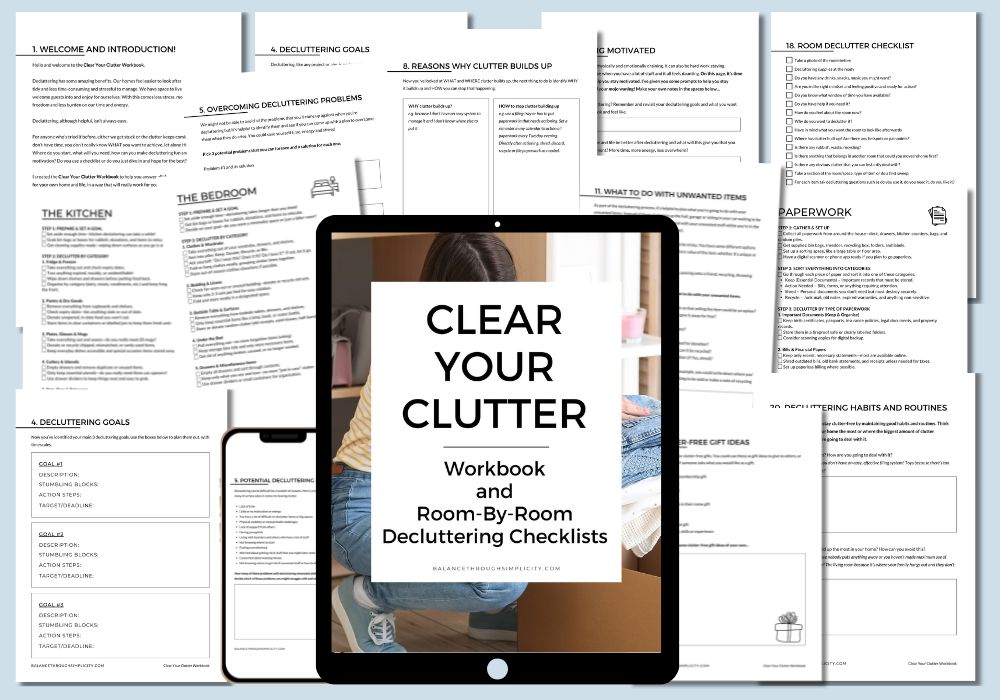
My Clear Your Clutter Workbook is designed to help you declutter every room of your home with confidence. It includes practical, step-by-step guidance, simple checklists and easy-to-follow projects that help you make steady progress without feeling overwhelmed.
From kitchens and wardrobes to paperwork, sentimental belongings, home offices and even your digital spaces, it’s packed with practical ideas to help you create a home that’s easier to manage and a pleasure to live in.
Because whether you’re decluttering your garden, your spare room or your kitchen cupboards, the goal is always the same:
To create a home that supports the life you want to live.
Learn more about the Clear Your Clutter Workbook here.
And over to you… I’d love to hear from you.
Do you enjoy gardening, or do you simply enjoy having a peaceful outdoor space to relax in?
Had you ever thought about applying your home decluttering principles to your garden before?
And if you could change just one thing about your outdoor space this weekend, what would it be?
Share your thoughts in the comments below. I always enjoy reading your ideas and hearing how you’re creating a home—and a garden—that works for you.
You Might Also Enjoy
If you’re looking for more ways to simplify your home and life, you might enjoy these articles next: