
Decluttering After Bereavement: 7 Gentle Ways to Start When You’re Ready
Decluttering after bereavement is one of the hardest parts of losing someone you love. In this article, you’ll find 7 gentle, practical ways to help you begin letting go with kindness, patience and without feeling rushed.
DECLUTTERING AFTER BEREAVEMENT: 7 GENTLE WAYS TO START LETTING GO
Losing someone you love is one of life’s most difficult experiences.
Whether you’ve lost a husband, wife, partner, parent, sibling or someone else who meant the world to you, I hope these ideas help you navigate one small part of an incredibly difficult journey.
The world can suddenly feel unfamiliar. Everyday routines change, your home feels different and even the simplest decisions can take more energy than they once did.
At some point, another difficult question often begins to surface:
What do I do with their things?
Perhaps you’ve walked past the same wardrobe every day for months without opening it.
Maybe their favourite chair is still exactly where they left it.
Or perhaps you’ve started thinking about downsizing, moving home or simply creating a little more space, but every time you begin, your emotions get in the way.
If that sounds familiar, I want you to know something before we go any further.
There is no right way to approach decluttering after bereavement and losing someone you love, and there’s no timetable you have to follow.
And there is certainly no rule that says you should have sorted everything out by now.
We all experience grief differently.
We all have different relationships with our possessions, our memories and the people we’ve loved. What feels right for one person may feel completely wrong for someone else.
This article isn’t about telling you what you should keep or what you should let go of.
Instead, it’s a collection of gentle ideas that may help if you’ve reached the point where you’re beginning to wonder whether you’re ready to make a start.
Take what feels helpful and leave what doesn’t.
Most of all, be kind to yourself.
WANT SOME HELP TO GET STARTED?
If you’re feeling overwhelmed and aren’t sure where to begin, my free Declutter Starter Kit will help you take those first steps without feeling like you have to tackle everything at once.
Inside you’ll find practical checklists, simple guidance and gentle encouragement to help you make steady progress, one small step at a time.
Why Decluttering After Bereavement Feels So Different
Most decluttering advice assumes you’re simply trying to organise your home.
But decluttering after bereavement is different.
You’re not just sorting through belongings. You’re sorting through a shared life.
A coat hanging behind the bedroom door.
- A favourite mug still sitting in the cupboard.
- Birthday cards.
- Handwritten notes.
- Holiday souvenirs.
- Receipts tucked inside drawers that haven’t been opened for years.
Each item can hold a memory, and sometimes those memories arrive when you least expect them.
It’s also about much more than the possessions themselves.
When you’ve spent years, or perhaps decades, sharing your life with someone, you’re often learning how to live as an individual again.
Alongside the emotional loss, there may be practical changes too—managing finances on your own, maintaining a home by yourself, or making decisions that you always used to make together.
No wonder that decluttering through grief can feel overwhelming.
Over the years, I’ve seen first-hand that there isn’t one “correct” way to approach this.
When my mum lost my dad, who had been a bit of a hoarder, she actually found it easier than she expected to let go of many of his belongings. Much of what he’d kept didn’t carry the same meaning for her, and creating a calmer home helped her begin the next chapter of her life.
My grandad’s experience was very different.
After my grandma died, her clothes stayed hanging in the wardrobe for a long time. For him, seeing them there brought comfort. Removing them straight away would simply have been too much.
Neither approach was right. Neither approach was wrong. They were simply two people finding their own way through grief.
Perhaps that’s the most important thing to remember.
Your journey doesn’t have to look like anyone else’s.
Try this:
- Give yourself permission to move at your own pace, even if it’s slower or faster than other people expect.
- Remember that there’s no deadline for making decisions about someone’s belongings.
- If you feel emotional, remind yourself that you’re not “bad at decluttering”—you’re processing love, loss and memories, all at the same time.
When Is the Right Time to Declutter After Someone Dies?
This is one of the questions people ask most often, and the honest answer is that there isn’t one.
Some people feel ready to sort through belongings within a few weeks or months because creating a calmer, more manageable home helps them regain a sense of control during an incredibly difficult time.
Others may need much longer before they can even think about opening a wardrobe or packing away personal possessions.
Neither approach is right or wrong.
Grief doesn’t follow a timetable, and neither does decluttering.
Your relationship with the person you’ve lost, the circumstances of their death, your personality, your family situation and even your relationship with possessions will all influence what feels right for you.
It’s also worth remembering that you don’t have to wait until you feel completely “ready.” For many people, that moment never comes. Instead, you might simply reach a point where you feel ready enough to begin with one small, practical step.
That could be clearing out expired food from the kitchen, sorting through paperwork or organising a single drawer.
- Starting doesn’t mean you have to finish.
- You can pause whenever you need to.
- You can change your mind.
- You can keep things you’re not ready to part with and come back to them months or even years later.
The important thing isn’t how quickly you declutter.
It’s that you approach the process with kindness, patience and compassion for yourself.
It’s also okay if you’re reading this and deciding that now isn’t the right time at all. You don’t have to declutter simply because other people think you should. This article is here if and when you decide you’d like to begin.
Try this:
- Let go of the idea that there’s a “right” time to begin. Trust your own instincts instead.
- Start with one small, practical task rather than something that carries lots of emotional memories.
- If a decision feels too difficult today, leave it for another day. There is no deadline.
7 Gentle Ways to Start Decluttering After Losing Someone You Love
If you’ve decided that now feels like the right time to begin, I hope these ideas help you take those first few steps with a little more confidence and a little less overwhelm.
1. Start When It Feels Right for You
People often mean well.
Family members may offer to help clear the house. Friends might gently suggest that “it’s time to move on.” Sometimes those comments come from kindness, but they can still leave you feeling pressured.
The truth is that only you know when you’re ready.
For some people, sorting through belongings soon after a bereavement feels practical and helps them regain a sense of control.
For others, it may take months or even years before they can think about opening certain cupboards or drawers.
Neither response is wrong.
What matters is that you’re making the decision because it feels right for you, not because you feel you ought to.
You don’t have to declutter everything at once.
You don’t even have to declutter anything today.
Simply recognising that you’re beginning to think about it is often the first step.
Try this:
- Ask yourself, “Am I doing this because I feel ready, or because I feel pressured?”
- If today doesn’t feel like the right day, allow yourself to wait without feeling guilty.
- When you do begin, choose a time when you won’t feel rushed or distracted.
2. Begin With the Practical Before the Precious
One of the kindest things you can do for yourself is avoid starting with the most emotional items.
- Photographs.
- Letters.
- Wedding cards.
- Jewellery.
- Clothes.
These are often the belongings that carry the strongest memories, and trying to make decisions about them too soon can leave you feeling emotionally exhausted.
Instead, begin somewhere more practical.
You might sort through the food cupboard, clear out expired toiletries or organise paperwork that’s no longer needed.
These small decisions build confidence without asking too much of your heart all at once.
As you begin to make progress, you’ll naturally develop more trust in your ability to make bigger decisions later on.
There is no prize for starting with the hardest category first.
Sometimes the gentlest approach is also the wisest.
Try this:
- Choose one small area that you can finish in about 20 or 30 minutes.
- Stop as soon as you feel yourself becoming emotionally tired, even if the space isn’t completely finished.
- Celebrate every small decision you make, because each one is helping you move forward.
3. Remember That Keeping Everything Isn’t the Same as Keeping Their Memory
One of the biggest fears people have when they begin decluttering after losing someone they love is this:
“If I let this go, will I lose a part of them too?”
It’s a completely understandable feeling.
Our possessions often become symbols of the people we love. A favourite jumper, a collection of books, a watch they wore every day or the mug they always reached for at breakfast can all feel as though they hold part of that person’s story.
Sometimes they do.
But over time, it’s worth gently reminding yourself that your memories don’t live inside those objects.
They live in you.
- The conversations you shared.
- The holidays you enjoyed.
- The ordinary Tuesday evenings that somehow became precious once they were gone.
Those memories aren’t dependent on how many belongings you keep.
That doesn’t mean you should get rid of everything. Far from it.
Some possessions will always deserve a place in your home because they bring comfort, make you smile or help you feel connected to someone you’ll always love.
The goal isn’t to remove every reminder. It’s simply to decide which reminders matter most.
For some people, that might mean keeping a favourite photograph on display, a handwritten recipe tucked safely in a drawer or a piece of jewellery that always reminds them of the person they loved.
Others create a memory box for letters, cards and small keepsakes, while some choose to scan photographs and important documents so they can preserve the memories without needing to keep every physical item.
There isn’t a right or wrong approach. The aim is simply to find a balance that feels meaningful and comforting to you.
Try this:
- Choose a few belongings that genuinely make you smile or bring you comfort, and give them a special place in your home.
- If there are sentimental items you aren’t ready to decide about, place them together in a clearly labelled memory box and come back to them another day.
- Remind yourself that letting go of an object doesn’t mean letting go of the love you shared.
4. Let Yourself Feel the Emotions Without Feeling You Have to Act on Them
Grief has a way of appearing when we least expect it.
You might open a kitchen drawer looking for batteries and suddenly find an old shopping list written in their handwriting.
You may discover a birthday card you’d forgotten about or come across the coat they always wore on winter walks.
Moments like these can stop you in your tracks.
If they do, that’s okay.
You don’t have to push your feelings aside in order to keep decluttering.
And you don’t have to make a decision just because you’ve picked something up.
Sometimes the kindest thing you can do is simply acknowledge the memory, close the drawer again and come back another day.
Progress isn’t measured by how many bags you donate. Sometimes it’s measured by the courage it took to open the cupboard in the first place.
Try this:
- If you become upset, pause for a few moments rather than forcing yourself to carry on.
- Keep some tissues, a cup of tea or a glass of water nearby and allow yourself time to breathe and gather your thoughts.
- Remember that it’s perfectly okay to stop for the day. The belongings will still be there when you’re ready.
5. Think About the Life You’re Creating as Well as the Life You’ve Lost
This can be one of the hardest parts of all.
When you’ve spent years as part of a couple, decluttering isn’t simply about deciding what to keep.
It’s also about quietly beginning to imagine the life that comes next.
- Perhaps you’re maintaining a home on your own for the first time.
- Perhaps you’re thinking about downsizing because the house feels too large.
- Perhaps you’re beginning to realise that your needs, routines and priorities have changed.
None of that means you’re leaving the past behind. It simply means life is asking something different of you now.
This can all feel unfamiliar at first. Decisions that were once shared suddenly become yours alone. You may find yourself asking not only what to do with someone’s belongings, but also what you want your own home and life to look like in the years ahead. Those are big questions, and they deserve time.
Creating a home that supports this next chapter isn’t an act of disloyalty.
In many ways, it’s an act of kindness towards yourself.
You can honour the past while still making room for the future. The two things can exist together.
Many people feel guilty when they begin letting things go. They worry that donating clothes, giving away treasured possessions or simply creating more space somehow means they’re being disloyal to the person they’ve lost.
If you’ve ever felt that way, please know you’re not alone.
Wanting a home that’s easier to manage doesn’t mean you’ve loved them any less, and choosing not to keep every belonging doesn’t diminish the life you shared together.
Sometimes the greatest act of love is keeping the memories that matter most while allowing yourself the freedom to move forward, one small step at a time.
Try this:
- As you look at an item, ask yourself, “Does this still have a place in the life I’m living now?”
- Imagine how you’d like your home to feel over the coming years. Calm? Manageable? Comfortable? Let that vision gently guide your decisions.
- Focus on making one thoughtful decision at a time rather than trying to plan everything at once.
WANT A LITTLE EXTRA SUPPORT?
If you’re finding it difficult to know where to begin, my free Declutter Starter Kit is designed to help you take the next step with confidence.
Inside you’ll find practical guidance, simple checklists and gentle encouragement to help you break the process down into manageable steps, so you can make steady progress without feeling overwhelmed.
6. Accept Help, But Keep the Decisions Yours
One of the kindest things people often do after a bereavement is offer to help clear the house.
Sometimes that’s exactly what you need. At other times, it can feel as though everything is happening too quickly.
The truth is, there’s a difference between accepting help and giving away the decisions.
You may appreciate someone helping you carry boxes to the car, taking donations to a charity shop or sorting paperwork into neat piles. Those practical tasks can make the whole process feel less exhausting.
But when it comes to deciding what stays and what goes, those choices are deeply personal.
Nobody else knows why one old cardigan makes you smile, or why one chipped teacup reminds you of Sunday afternoons together.
If you’re sorting through belongings with siblings, children or other family members, remember that everyone will have their own memories and emotional attachments.
One person may find it easy to let something go, while another may feel strongly that it should be kept.
Try to approach those conversations with patience and understanding, recognising that grief often looks different for each of us.
Equally, nobody else should make you feel guilty if you’re not ready to let something go.
Whether you choose to keep a room exactly as it is for a while, or whether you decide to make changes quite quickly, your decisions are valid because they’re yours.
Try not to compare your journey with anyone else’s.
There isn’t a “right” amount to keep. There isn’t a “right” time to begin.
There is only what feels right for you.
Try this:
- Accept help with practical jobs, but don’t feel rushed into making emotional decisions.
- If family members have strong opinions, explain gently that you need to work through things in your own time.
- Remember that you can always say, “I’m not ready to decide about that today.”
7. Moving Forward Doesn’t Mean Leaving Them Behind
Perhaps this is the most important thing I want to leave you with.
Many people worry that if they begin decluttering, they’re somehow closing a chapter they aren’t ready to close.
They wonder whether donating clothes, rearranging furniture or creating more space means they’re leaving their loved one behind.
I don’t believe that’s true.
The people we love become part of who we are.
They’ve shaped our lives, influenced our memories and helped make us the people we are today. Those things don’t disappear because you decide to clear a cupboard or donate a coat.
Love isn’t measured by how many belongings you keep. Neither is grief.
Over time, many people discover that surrounding themselves with a few meaningful possessions brings far more comfort than trying to preserve everything exactly as it was.
- A favourite photograph displayed on a shelf.
- A wedding ring kept somewhere safe.
- A recipe book with handwritten notes in the margin.
- A garden bench where you still enjoy your morning cup of tea.
Sometimes it’s these carefully chosen reminders that keep someone’s memory alive most beautifully.
Creating a home that feels calmer, safer and easier to manage isn’t about forgetting the past.
It’s about giving yourself permission to live well in the present while carrying your memories into the future.
Those two things can exist side by side.
Try this:
- Choose a few meaningful items that truly reflect the person you loved, rather than feeling you need to keep everything.
- As you make decisions, remind yourself that memories live in your heart, not just in your home.
- Give yourself permission to create a home that supports the life you’re living now, while still honouring the life you’ve shared.
Need a Little More Guidance?
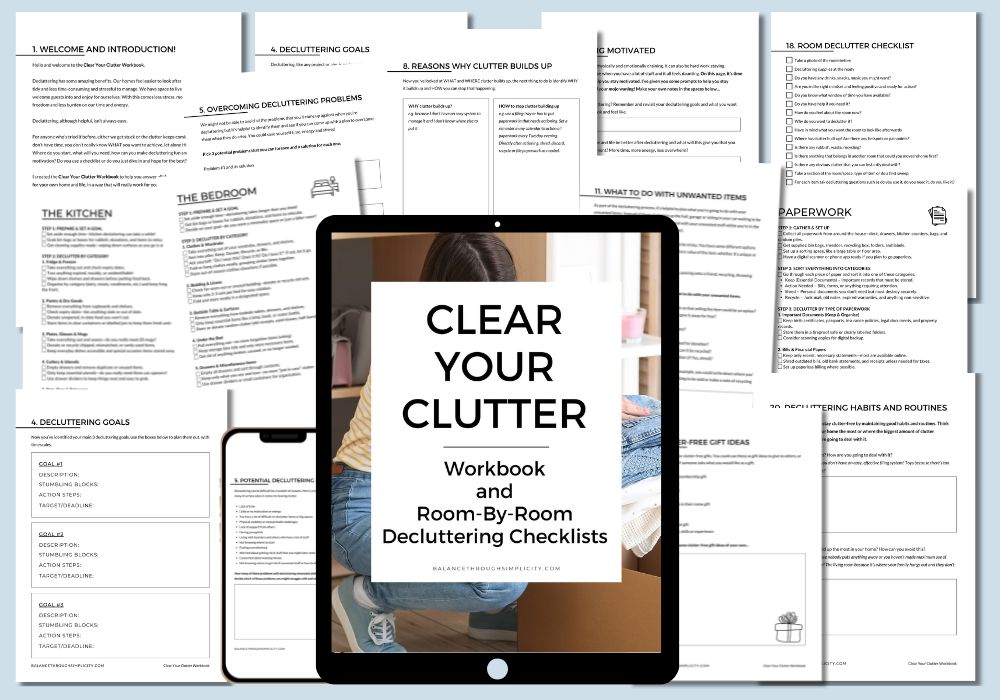
If you’re looking for a gentle, practical plan to help you work through your home one step at a time, my Clear Your Clutter Workbook is designed to guide you through the process without feeling overwhelmed.
Rather than wondering where to start next, you’ll have simple room-by-room guidance, thoughtful prompts and practical exercises that help you make steady progress at a pace that feels right for you.
There’s no pressure to rush, no unrealistic expectations and no complicated systems to follow.
Just gentle encouragement and a clear plan to help you create a home that feels lighter, calmer and easier to manage, one small step at a time.
Learn more about the Clear Your Clutter Workbook.
One Small Step Is Enough
If you’ve read this article because you’re trying to work out what to do with the belongings of someone you love, I hope you’ll remember one thing above everything else.
You don’t have to do this perfectly. You don’t have to do it quickly. And you certainly don’t have to do it the same way as anybody else.
Grief is deeply personal.
So is decluttering after bereavement.
For some people, creating space helps them begin a new chapter. For others, holding onto things for a little longer brings comfort and reassurance.
Neither approach is wrong.
The important thing is that your home supports you, wherever you are in your journey.
Some days that might mean filling a donation bag. Other days it might simply mean opening a cupboard, looking inside and deciding that today isn’t the day.
Both are progress because progress isn’t always measured by how much you’ve cleared.
Sometimes it’s measured by having the courage to take the next small step, however small that step may be.
Be patient with yourself. Be gentle with yourself and trust that, when you’re ready, you’ll know what feels right.
The person you love will always be part of your story. The memories you’ve made together don’t disappear because your home begins to change.
As you move forward, I hope you’re able to create a home that not only honours the past but also gently supports the life that’s still waiting to be lived.
Related Articles
You might also enjoy:
- 7 Ways to Start Decluttering When You Have a Lifetime of Stuff
- Swedish Death Cleaning: What It Is and How to Use This Decluttering Method
- The Hidden Costs of Clutter
- 7 Reasons Why Decluttering Now Could Be One of the Kindest Gifts You Leave Your Children
- How to Declutter Without Throwing Away Your Memories
- Helpful Decluttering Tips for Seniors
- 7 Signs It’s Time to Let Go of the Stuff That’s Holding You Back (And What to Do About It)
Hi Nancy, it’s always a difficult topic to write about and really there are no right or wrong ways to declutter. But, I hope these ideas might help.
Hi Alan, thank you for sharing that. Decluttering is very much about peeling back the layers.
Really appreciated this piece. I haven’t had a bereavement but have reached an age -69- where I am very aware that I don’t want to leave a lot of work behind when I go. This piece was good in that it helped me to think about personal and sentimental items.
I have to declutter slowly, layer by layer, sifting, like an archaeologist. But I have now got down to certain depth. and I have begun to look at certain personal items, like things I myself wrote (at school!), concert programmes, cards. I have no children, and no nephews and nieces. So quite simply no one will be interested in them, when I’m not here. I really began to question why some of these items were kept. They represent a past, or a past moment, and I have got used to them being safely stashed… but as I don’t look at them, I wonder what they are really doing in their respective storage boxes or folders…and I am taking a breath before gently taking away another layer. Thank you.
Thank You so much Antonia for this article, most people have lost a love one so it is a great help. I specially liked the part of the memories staying with us, despite our home may change.
Nancy