
7 Signs It’s Time to Let Go of the Stuff That’s Holding You Back (And What to Do About It)
If you’re wondering whether it’s time to let go of the stuff that’s holding you back, you’re not alone. From overflowing cupboards to sentimental belongings, the things we keep can quietly add stress, overwhelm and mental clutter. In this article, you’ll discover seven signs it’s time to let go—and simple, practical ways to create a home that feels lighter, calmer and easier to enjoy.
IS IT TIME TO LET GO OF STUFF THAT’S HOLDING YOU BACK?
If you’ve been wondering whether it’s time to let go of the stuff that’s holding you back, you’re not alone. Many of us reach a point where our belongings no longer support the life we’re living today. Instead, they create stress, guilt and overwhelm. Recognising the signs is often the first step towards creating a home that feels lighter, calmer and easier to enjoy.
There comes a point when decluttering stops being about having a tidier home. Instead, it becomes about creating space for the life you want to live.
I know that feeling well. Over the years, I’ve decluttered cupboards, wardrobes, paperwork, sentimental keepsakes and countless boxes tucked away “just in case”. Some things were easy to let go of. Others felt surprisingly difficult, even when I hadn’t looked at them for years.
What I’ve learned is that we don’t usually hold onto things because we need them. We hold onto them because of what they represent.
- Sometimes it’s the past.
- Sometimes it’s guilt.
- Sometimes it’s hope for a future version of ourselves.
And sometimes it’s simply because we haven’t stopped long enough to ask whether those things still deserve a place in our lives.
7 SIGNS IT’S TIME TO LET GO OF STUFF THAT’S HOLDING YOU BACK
If you’ve been feeling weighed down by your home lately, these seven signs might help you recognise whether it’s time to let go of the things that are quietly holding you back.
1. Your Home Feels Heavy Instead of Comforting
Home should be somewhere you can exhale.
It doesn’t have to be spotless or look like something from a magazine, but it should feel like somewhere you enjoy spending time.
If you walk through the front door and immediately notice jobs that need doing, piles that need sorting or cupboards that are bursting at the seams, it’s worth paying attention to that feeling.
Clutter creates more than physical mess. It creates mental noise.
Even when you’re not actively thinking about it, your brain is constantly processing everything around you. Every overflowing shelf, every box waiting to be sorted and every surface covered in belongings quietly competes for your attention.
I remember standing in my aunt’s spare room one afternoon, looking at boxes of stuff she hadn’t sorted through, or even looked at for years.
When we chatted about what she wanted to do with them, she realised they weren’t adding anything to her life—they were simply taking up space, both physically and mentally.
Yes, they held memories and/or were useful, but actually what she wanted was less stuff to store, more space to move around safely and not to worry about how much stuff she was leaving behind for her children to declutter in time to come.
That was the moment she stopped asking, “Where can I store this?” and started asking, “Do I still need this at all?”
Try this:
- Choose one small area that makes your home feel heavy—a shelf, a bedside drawer or one basket that’s overflowing.
- Spend just ten minutes removing anything that no longer serves you.
- Notice how that small change affects the way the space feels.
2. You Keep Organising Instead of Letting Go
Buying another storage basket can feel productive.
Rearranging cupboards can make you feel as though you’re making progress.
Labelling containers is satisfying.
But none of those things reduce the amount of stuff you own.
For years, before I learned about decluttering, I thought I needed better organisation. I moved things from room to room, bought containers and carefully folded everything so it fitted neatly.
The problem wasn’t organisation.
The problem was simply that I owned more than my home needed to hold.
Organisation is wonderful once you’ve decided what deserves to stay. But if you’re constantly trying to find somewhere to squeeze everything in, it may be a sign that your home needs less—not more storage.
Try this:
- Before buying another storage solution, ask yourself one simple question: “If I let go of twenty items from this space, would I still need another basket?” Often the answer is no.
3. You Can’t Find the Things You Actually Use
Have you ever bought something, only to discover you already had one tucked away in a cupboard?
Or spent ten frustrating minutes searching for an important document, your favourite pair of scissors or the tape measure, knowing it’s “somewhere” but not being able to remember where?
My hoarder husband knows about this only too well!
When we own more than we can comfortably manage, even everyday tasks become harder than they need to be.
The irony is that the items we use most often can become buried beneath the things we rarely use at all.
Our homes should make life easier, not more complicated.
If you’re constantly searching for things, moving piles from one place to another or buying duplicates because you can’t find the originals, it may be a sign that your belongings have reached the point where they’re no longer serving you.
Decluttering isn’t just about creating empty space. It’s about making room for the things that genuinely add value to your everyday life.
Try this:
- Choose one area where you regularly waste time looking for things, such as your kitchen drawer, handbag, hallway cupboard or paperwork.
- Remove anything you don’t use regularly so the items you rely on are easy to find.
4. You Feel Guilty Every Time You Open a Cupboard
Sometimes clutter isn’t stressful because of what it is but because of what it reminds us of.
- The unopened craft supplies.
- The exercise equipment we promised ourselves we’d use.
- The clothes that no longer fit.
- The kitchen gadgets that seemed like a good idea at the time.
Each item can carry a little voice saying, “You should use me. You spent money on me. Don’t waste me.”
Before long, opening a cupboard doesn’t just reveal belongings. It brings a wave of guilt.
I’ve certainly experienced this myself. For a long time, I held onto books I genuinely intended to read “one day”. Every time I looked at the growing pile, I felt a little disappointed that I hadn’t made time for them yet.
Eventually I realised the books weren’t inspiring me to read more. Instead, they were simply making me feel as though I was always falling behind.
Once I accepted that I couldn’t read everything, it became much easier to pass many of them on to someone else who would enjoy them now.
Your home shouldn’t make you feel guilty.
It should support the person you are today, not constantly remind you of everything you haven’t done.
Try this:
- Find one item that makes you feel guilty every time you see it.
- Ask yourself whether you’re keeping it because it genuinely improves your life—or because you’re holding onto the guilt attached to it.
- If it’s the latter, give yourself permission to let both go together.
5. Your Belongings Remind You More of Who You Were Than Who You Are Now
Life changes and our homes should be allowed to change with us.
- Perhaps you’ve changed career.
- Your children have grown up.
- You’ve retired.
- You’ve discovered new interests.
Or maybe you’ve simply become someone who values calm and simplicity more than having lots of possessions. Yes, that’s me!
Yet many of us continue to hold onto things that belong to a previous chapter of our lives.
- Boxes of hobbies we no longer enjoy.
- Clothes that reflected a different lifestyle.
- Equipment for projects we’ve quietly moved on from.
Keeping a few meaningful reminders is part of preserving our memories. Keeping everything, however, can make it difficult to embrace the life you’re living now.
I’ve found that decluttering often isn’t about letting go of the past. It’s about making enough space for the present.
When your home reflects who you are today instead of who you used to be, it becomes much easier to appreciate both without feeling stuck between them.
Try this:
- Walk around your home and notice whether there are items that represent a version of yourself you’ve already outgrown.
- Choose just one to donate, recycle or pass on, and remind yourself that letting go of an object doesn’t erase the memories or experiences connected to it.
6. You Keep Putting Off the Life You Want to Live
One of the biggest surprises I’ve discovered through decluttering is that clutter doesn’t just take up space in your home.
It takes up space in your mind.
Sometimes we tell ourselves…
- We’ll invite friends over once the house is tidier.
- We’ll start that new hobby when we’ve cleared the spare room.
- We’ll decorate once we’ve sorted the garage.
- We’ll relax when we’ve finally finished organising everything.
The trouble is, “one day” has a habit of turning into months or even years.
Our homes are meant to support our lives, not put them on hold.
If you’ve been waiting for the perfect time to enjoy your home, it may be worth asking whether the things inside it are stopping you from living the life you want today.
Your home doesn’t need to be perfect to be welcoming.
It doesn’t need to be finished before you can enjoy it.
Sometimes letting go of a few possessions creates enough breathing room to start saying yes to the things that matter most.
Try this:
- Finish this sentence: “I’d love to ________, but I can’t because…”
- If your answer has anything to do with clutter or lack of space, choose one small action today that moves you closer to changing that.
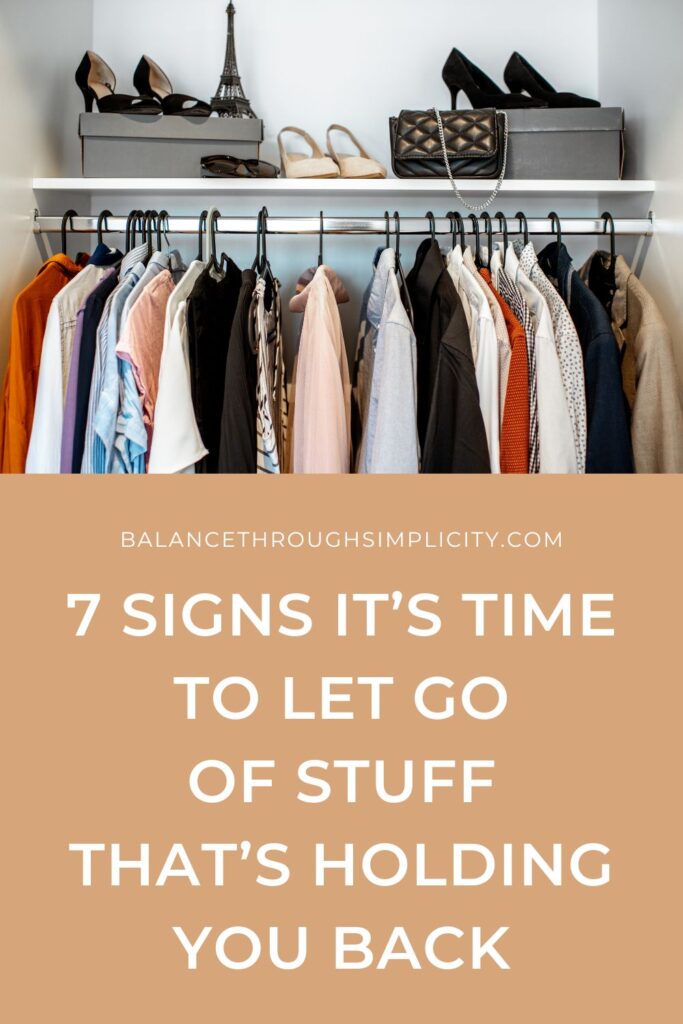
7. Deep Down, You Already Know It’s Time
Perhaps this is the biggest sign of all.
If you’ve read this far, there’s a good chance that part of you already knows something needs to change.
- Not because someone else says you own too much.
- Not because you have to become a minimalist.
- Not because your home has to look a certain way.
But because you’re ready for your home to feel lighter, calmer and easier to live in.
The truth is, decluttering isn’t about getting rid of everything. It’s about choosing what deserves a place in your life.
Over the years, I’ve learned that every item we let go of creates a little more space—not just in our cupboards, but in our routines, our decisions and even our thoughts.
Small changes really do add up.
You don’t have to declutter your whole house this weekend.
You simply need to begin somewhere.
Try this:
- Pick one drawer, one shelf or one small basket. Set a timer for ten minutes and see what you can let go of.
- Don’t worry about finishing the job.
- Focus on building the habit of making thoughtful decisions, one item at a time.
REMEMBER, YOU’RE NOT JUST DECLUTTERING YOUR HOME
It’s easy to think decluttering is about creating empty cupboards or tidy shelves.
But the longer I’ve been helping people simplify their homes, the more I’ve realised it’s about something much deeper than that.
It’s about making everyday life feel easier. It’s about reducing the constant decisions, distractions and overwhelm that come from owning more than we need.
It’s about creating a home that supports the life you’re living now—not the one you lived ten years ago, or the one you think you should be living.
Every item you choose to let go of is another step towards a home that feels calmer, more manageable and more enjoyable to spend time in.
You don’t have to do it all at once but just one small step at a time.
READY TO DECLUTTER WITH MORE CONFIDENCE?
If today’s article has helped you recognise some of the stuff that’s holding you back, why not take the next step?
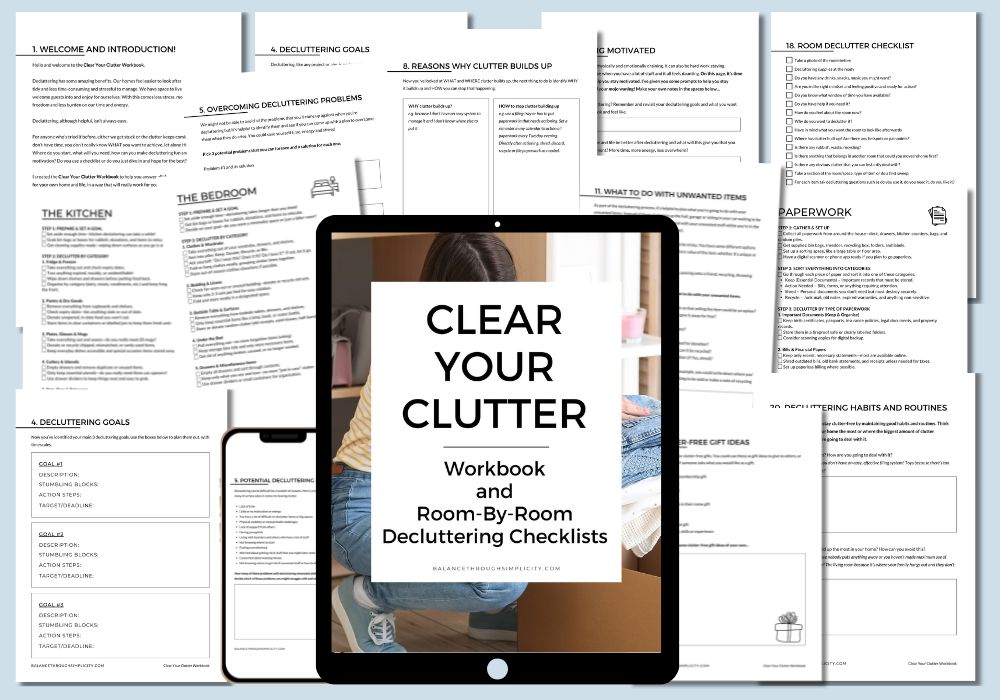
My Clear Your Clutter Workbook is designed to help you move beyond feeling overwhelmed and start making steady, meaningful progress.
Inside, you’ll find practical exercises, room-by-room guidance, decluttering prompts and simple strategies to help you make confident decisions about what to keep and what to let go of.
Whether you’re tackling one drawer or your entire home, the workbook will help you stay focused, motivated and encouraged every step of the way.
Remember, you don’t need a perfect home. You simply need a home that gives you more space to enjoy the life that’s happening inside it.
One small decision today could be the beginning of lasting change.
Learn more about the Clear Your Clutter Workbook.
And over to you… Have you recognised any of these signs in your own home? I’d love to hear your thoughts in the comments below. Which sign resonated with you the most, and what’s one small step you could take today to let go of the stuff that’s holding you back? Your experience might be just the encouragement someone else needs to get started.
Here are some more articles you might find helpful:
Hi Nancy, I’m glad you found the article and ideas helpful. I’m also sure you’re not alone in buying storage before working out if you really need it!
Hi Antonia, I’m guilty for the second sign, yesterday I bought 2 organising baskets without having decluttered the space yet…
I relate to all of the signs in this article, thank you so much for the advice on each “try this” section.
Nancy